If your boiler has started banging, whistling, humming, vibrating or making gurgling sounds, it can be worrying, especially during colder months when heating and hot water are essential. Some boiler noises are harmless operating sounds, but new, loud or repeated noises can point to trapped air, low pressure, limescale, sludge, circulation issues or worn internal parts. For homeowners and landlords in Fulham, working with Citywide Plumbers helps you understand whether the noise is a simple heating system issue or a warning sign that needs professional attention.
A boiler does not need to be completely silent. You may hear soft clicking as it starts, a gentle hum from the pump or fan, or water moving through the system. The concern begins when the sound changes suddenly, becomes much louder than usual, happens repeatedly, or is accompanied by pressure loss, leaks, poor heating, hot water problems, error codes or unusual smells.
This guide explains the most common reasons a boiler becomes noisy, what different sounds may mean, what checks are safe for a homeowner to make, and when you should arrange a professional inspection. It is written for London and Fulham homes, where older pipework, compact flats, hard water, converted buildings and busy heating systems can all contribute to boiler noise.
Important: Do not open the boiler casing or attempt gas-related repairs yourself. If you smell gas, suspect carbon monoxide, notice soot marks, or feel unwell, turn off the appliance if safe, ventilate the property and contact the appropriate emergency service.
Noisy Boiler Infographic Guide
This quick visual guide summarises the most common boiler noises, possible causes, safe checks and warning signs that should not be ignored.
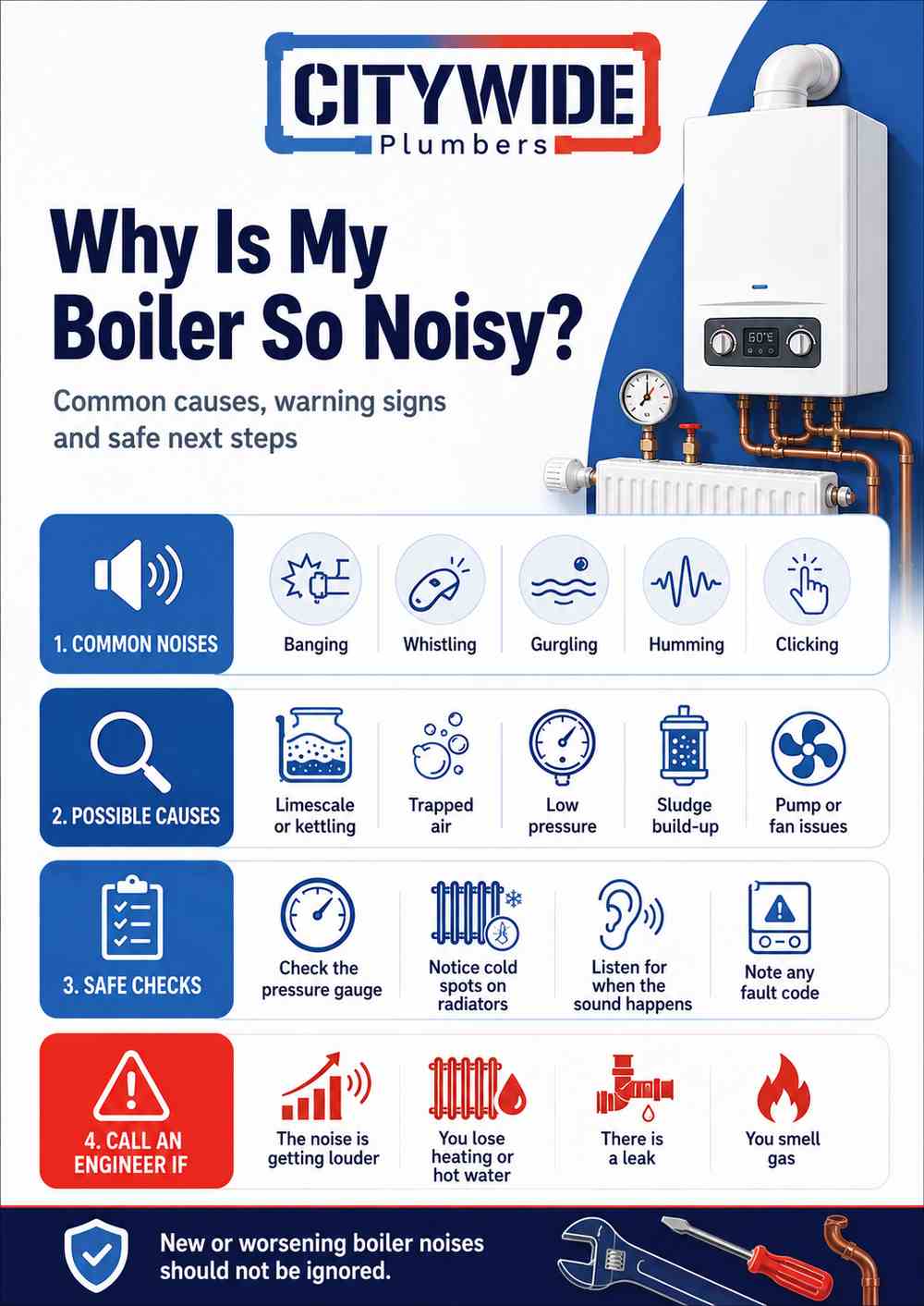
Click the infographic to enlarge
Is It Normal for a Boiler to Make Noise?
Most boilers make some level of sound during normal operation. When the heating turns on, you may hear the boiler firing up, the pump circulating water, a small click from internal controls or a soft hum from electrical components. These sounds are usually consistent, quiet and short-lived.
However, a boiler that suddenly becomes noisy should not be ignored. A new sound often means something has changed inside the boiler or wider central heating system. It could be as simple as trapped air in a radiator, or it could involve scale build-up, blocked circulation, a faulty pump, a fan issue, a failing valve or a pressure-related problem.
The key is to listen to the type of noise, when it happens and whether it is getting worse. Does it happen only when the heating starts? Is it louder when hot water is running? Does it stop when the pressure is corrected? Are certain radiators cold at the top or bottom? These details help a heating engineer diagnose the issue faster.
- Quiet clicking during start-up can be normal
- A gentle hum may come from the pump or fan
- Loud banging should always be investigated
- Gurgling often suggests air or circulation problems
- Whistling can point to kettling or restricted flow
- New or worsening sounds need professional attention
Why Is My Boiler Making Banging or Kettling Noises?
Banging is one of the most common boiler noise complaints. It can sound like knocking, thudding, popping or a kettle boiling loudly. In many cases, this is connected to a problem called kettling. Kettling happens when water inside the boiler overheats or struggles to circulate properly, creating steam bubbles and sudden noise.
In London properties, kettling can be made worse by hard water, limescale and older heating systems. Over time, minerals, sludge and debris can collect around the heat exchanger or inside pipework. When water flow is restricted, the boiler has to work harder, and hot spots can develop. This may create the banging or boiling sound many homeowners hear.
Banging can also be linked to trapped air, a pump that is not circulating water correctly, a blocked pipe, incorrect pressure or loose pipework expanding and contracting as the system heats up. The cause is not always visible from the outside, so repeated banging should be checked properly.
If the banging is occasional and happens only as pipes warm up, it may be pipe expansion. If it is loud, repeated, comes from the boiler itself or is accompanied by poor heating, it is more serious. A professional may need to check circulation, flush sludge, inspect the pump, clean components or identify whether a part is failing.
- Limescale can restrict water flow
- Sludge can reduce circulation through radiators
- Trapped air may cause knocking or uneven heating
- A faulty pump can create overheating issues
- Loose pipework may knock as it expands
- Repeated banging should not be ignored
Why Is My Boiler Whistling or Making a High-Pitched Noise?
A whistling boiler can sound similar to a kettle, a high-pitched squeal or a sharp tone when the system is working. This type of noise is often associated with restricted water flow, kettling, pressure problems or a component working under strain.
When water cannot move smoothly through the heat exchanger, pipework or valves, the boiler may make a whistling sound as heat and pressure build up in the wrong place. Scale, sludge, closed valves, a blocked filter or circulation issues can all contribute. In some cases, the sound may come from a fan, pump or internal part rather than the water itself.
Whistling should be treated carefully because the same sound can have different causes. It may be a system issue that can be improved with cleaning, balancing or servicing, but it may also point to a part that is wearing out. If the noise is new, persistent or becoming louder, arrange a professional inspection rather than waiting for the boiler to fail.
Homeowners sometimes try to solve whistling by turning settings up or down repeatedly, but that does not address the underlying cause. A heating engineer can check flow temperature, pressure, circulation, filters and internal components to find the real problem.
Why Is My Boiler Gurgling?
Gurgling is usually linked to air or water movement inside the heating system. You may hear it in the boiler, radiators, pipes or airing cupboard. It can sound like bubbling, sloshing or water moving unevenly through the system.
One common cause is trapped air. Air pockets can stop water from circulating smoothly, which may also leave radiators cold at the top. If one or more radiators are cooler at the top than the bottom, bleeding the radiator may help. However, if the problem keeps coming back, there may be a pressure issue, leak, poor circulation or a fault allowing air into the system.
Low boiler pressure can also cause gurgling. Modern sealed systems usually need pressure within the manufacturer’s recommended range. If pressure drops too low, water may not circulate correctly, and the boiler may become noisy or show an error code. Topping up pressure can sometimes help, but repeated pressure loss needs investigation.
Gurgling can also be linked to sludge. If radiators are cold at the bottom, slow to heat or noisy when the heating starts, sludge may be restricting circulation. In that situation, the solution may involve system cleaning, inhibitor, magnetic filtration or a more detailed heating system assessment.
- Gurgling often means trapped air
- Low pressure can affect water circulation
- Cold radiator tops may need bleeding
- Cold radiator bottoms can suggest sludge
- Repeated pressure loss should be checked
- Ongoing gurgling may need system cleaning
Why Is My Boiler Humming, Vibrating or Buzzing?
A low hum can be normal, especially when the pump or fan is running. The issue becomes more concerning when the hum is louder than usual, turns into vibration, travels through walls or happens even when the boiler should be quiet.
Vibration can be caused by a pump running too fast, loose casing panels, pipework touching walls or floors, worn bearings, fan problems or internal parts that are no longer operating smoothly. In flats and terraced homes, vibration may also be amplified by cupboards, boxed-in pipework or shared walls.
Buzzing may point to an electrical component, valve, transformer or control issue. This is not something a homeowner should repair. Electrical and gas appliance components should be checked by a qualified professional because incorrect repair attempts can create further damage or safety risks.
If the vibration is mild and appears to come from visible pipework outside the boiler, lagging or securing the pipe may help. But if the vibration comes from inside the boiler, do not remove the cover. A Gas Safe registered engineer should inspect the appliance and confirm what is causing the sound.
Why Is My Boiler Clicking, Tapping or Knocking?
Clicking can be a normal part of boiler operation. Boilers use controls, relays and ignition sequences, so a soft click when the boiler starts or stops is not automatically a problem. The concern is repeated clicking, loud tapping, irregular ignition attempts or clicking combined with no heating or hot water.
Tapping noises may come from expanding pipework as hot water moves through the system. Pipes that are fitted too tightly, pass through timber, or sit against walls and floors can knock as they heat and cool. This is common in older properties and converted London homes where pipe routes are not always ideal.
Knocking from radiators or pipes may also suggest trapped air, pressure changes or circulation problems. If radiators heat unevenly, the system takes a long time to warm up or the boiler cycles on and off frequently, the noise may be part of a wider heating issue.
Repeated clicking from the boiler itself can be more serious. It may involve ignition, sensors, controls or internal components. If the boiler tries to start but fails, shows a fault code or locks out, arrange a professional inspection rather than resetting it repeatedly.
How Pressure, Air and Circulation Problems Make Boilers Noisy
Many noisy boiler issues are connected to three things: pressure, air and circulation. A boiler needs the right system pressure, clear water flow and properly balanced heating circuits to work quietly and efficiently. When one of these is wrong, noise often follows.
Low pressure can stop water moving properly around the heating system. High pressure can place strain on components and may cause discharge from the pressure relief system. Trapped air can make radiators noisy, reduce heat output and create gurgling or knocking. Poor circulation can cause hot spots, kettling and uneven heating.
Sludge is another major circulation problem. As radiators and pipework age, black iron oxide sludge can build up. This debris can collect in radiators, valves, pipework and the boiler. It may create cold spots, noisy circulation, pump strain and reduced efficiency. In some cases, a heating engineer may recommend a filter, chemical clean or power flush depending on the condition of the system.
This is why boiler noise should not be treated as a single issue. The sound may be coming from the boiler, but the cause may be elsewhere in the heating system. A proper diagnosis looks at the boiler, radiators, pressure gauge, pipework, valves, pump, filters and overall system performance.
| Noise Type |
Possible Cause |
What It May Indicate |
| Banging or popping |
Kettling, sludge, limescale or poor circulation |
Water may be overheating or restricted inside the system |
| Whistling |
Restricted flow, pressure issue or worn component |
The boiler may be working under strain |
| Gurgling |
Trapped air, low pressure or water movement |
The system may need bleeding, pressure correction or inspection |
| Vibrating |
Pump, fan, loose pipework or internal component |
A part may be loose, worn or incorrectly operating |
| Clicking repeatedly |
Ignition, controls, sensors or failed start-up |
The boiler may need professional fault diagnosis |
When Is a Noisy Boiler an Urgent Problem?
Some boiler noises can wait for a booked service, but others should be treated as urgent. If the noise is sudden, very loud, repeated or combined with other warning signs, it is safer to stop using the appliance and arrange a qualified inspection.
Urgent signs include a smell of gas, soot or staining around the appliance, a yellow or unstable flame on older visible-flame appliances, repeated lockouts, error codes, leaking water, pressure rising or falling quickly, no heating or hot water, or symptoms that could suggest carbon monoxide exposure such as headaches, dizziness, nausea or tiredness when at home.
If you smell gas, do not use electrical switches, do not smoke, open doors and windows if safe, leave the property and call the National Gas Emergency Service on 0800 111 999. If carbon monoxide is suspected, move into fresh air and seek appropriate emergency advice.
Never remove the boiler casing to investigate a noise. The casing forms part of the appliance safety design. Internal checks, gas adjustments, combustion checks and component repairs should only be carried out by a suitably qualified Gas Safe registered engineer.
- Gas smell should be treated as an emergency
- Soot marks can suggest unsafe combustion
- Repeated lockouts need fault diagnosis
- Leaks and pressure changes should be checked
- Carbon monoxide symptoms need immediate action
- Internal boiler repairs are not DIY work
Safe Checks You Can Make Before Calling an Engineer
There are a few simple checks homeowners can make without opening the boiler or touching gas components. These checks can help you describe the problem clearly when booking a repair or Boiler Service in Fulham.
First, note when the noise happens. Is it during heating, hot water use, start-up, shutdown or all the time? Next, check the boiler pressure gauge when the system is cool. If the pressure is outside the manufacturer’s recommended range, the system may need attention. Do not keep topping up pressure again and again without finding out why it is dropping.
Check your radiators. If they are cold at the top, trapped air may be present. If they are cold at the bottom, sludge may be restricting heat flow. Listen for noise in specific radiators or pipe runs. Sometimes the boiler sounds noisy because the wider system is moving water unevenly.
You can also make sure visible radiator valves are open, thermostats are set correctly and the boiler has not displayed an error code. Write down any fault code before resetting the boiler. Repeated resetting is not a repair and may delay proper diagnosis.
- Record when the sound happens
- Check the pressure gauge when the system is cool
- Look for radiator cold spots
- Note any fault codes before resetting
- Check whether the noise is from pipes or the boiler
- Do not remove the boiler cover
How Regular Boiler Servicing Helps Prevent Noisy Boiler Problems
Regular servicing is one of the best ways to reduce the risk of boiler noise becoming a major breakdown. During a service, an engineer can check safety, operation, condition, pressure, combustion, seals, flue performance and visible signs of wear. They can also identify early problems before they become expensive repairs.
In Fulham and wider London homes, boilers often work hard through winter and may be installed in cupboards, compact kitchens, utility spaces or converted flats. Limited ventilation around the appliance, older pipework, hard water and heavy use can all increase the importance of proper maintenance.
A service may not solve every noise immediately, especially if the cause is sludge in the wider system or a failing component. However, it gives a qualified engineer the chance to inspect the appliance, assess performance and advise whether cleaning, repair, balancing or replacement parts are needed.
If your boiler is noisy and overdue for maintenance, booking Expert Boiler Installation, Repairs & Servicing in Fulham can help protect heating performance, improve safety and reduce the chance of a sudden winter breakdown.
Why Fulham Homes Often Experience Boiler Noise
Fulham has a wide mix of property types, from period terraces and mansion flats to renovated apartments, rental homes and modern developments. Each property type can have different heating challenges. Older homes may have ageing pipework, converted layouts or radiators added at different times. Flats may have compact boiler cupboards and short but busy pipe runs. Renovated properties may have newer boilers connected to older heating circuits.
Hard water can also be a factor across many London areas. Where scale builds up inside heating components, water flow can become restricted and boiler noise may increase. If the system has not been cleaned or protected with inhibitor, sludge and debris may also collect over time.
Landlords should pay particular attention to noisy boilers because tenants may report sounds only after the issue has been developing for some time. Early inspection can prevent complaints, reduce repair costs and help keep the property safe and comfortable.
For homeowners, a noisy boiler is a useful warning sign. It does not always mean the boiler needs replacing, but it does mean the heating system deserves attention. The sooner the cause is found, the easier it is to protect the boiler and avoid a full loss of heating or hot water.
Final Thoughts: Do Not Ignore a Boiler That Sounds Different
A noisy boiler is your heating system’s way of telling you something has changed. The sound may be caused by trapped air, pressure loss, limescale, sludge, pipe movement, a pump issue, a fan problem or a worn internal component. Some causes are minor, but others can lead to poor efficiency, repeated breakdowns or safety concerns if ignored.
The most important thing is not to guess. Listen to the sound, check safe external indicators such as pressure and radiator performance, record any error codes and arrange a professional inspection if the noise is new, loud, persistent or linked to poor heating and hot water.
Whether you need advice about banging, whistling, gurgling, vibration, pressure loss or a full boiler service in Fulham, Citywide Plumbers can help diagnose the problem, service your boiler and keep your heating system working safely and reliably across Fulham and London.
Need Help with a Noisy Boiler in Fulham?
Citywide Plumbers provides professional boiler servicing, repairs, installation support and heating fault diagnosis for homes and rental properties in Fulham and nearby London areas.
Book Boiler Servicing in Fulham