If your boiler is working but no hot water is coming from the taps, the situation can be confusing. The radiators may heat normally, the boiler may sound active, and the display may look fine, yet the shower, bath or kitchen tap stays cold. For homeowners and landlords who need reliable help from Citywide Plumbers, understanding the likely causes can help you decide what to check safely and when to arrange professional boiler support.
This problem is especially disruptive in London homes, where many flats and houses rely on a combi boiler for both central heating and instant hot water. In a busy household, losing hot water affects showers, washing up, cleaning, laundry and daily comfort. The good news is that some causes are simple, such as a control setting, pressure issue or temporary lockout. Other causes need a qualified engineer because they may involve internal boiler parts.
This guide explains why a boiler may appear to be working while hot water is not reaching your taps. It covers safe checks, common causes, warning signs, repair possibilities and when a boiler service or professional diagnosis is the right next step.
Boiler Working But No Hot Water Infographic
This visual guide summarises the most common causes, safe checks, warning signs and professional repair points when a boiler is running but hot water is not reaching taps or showers.
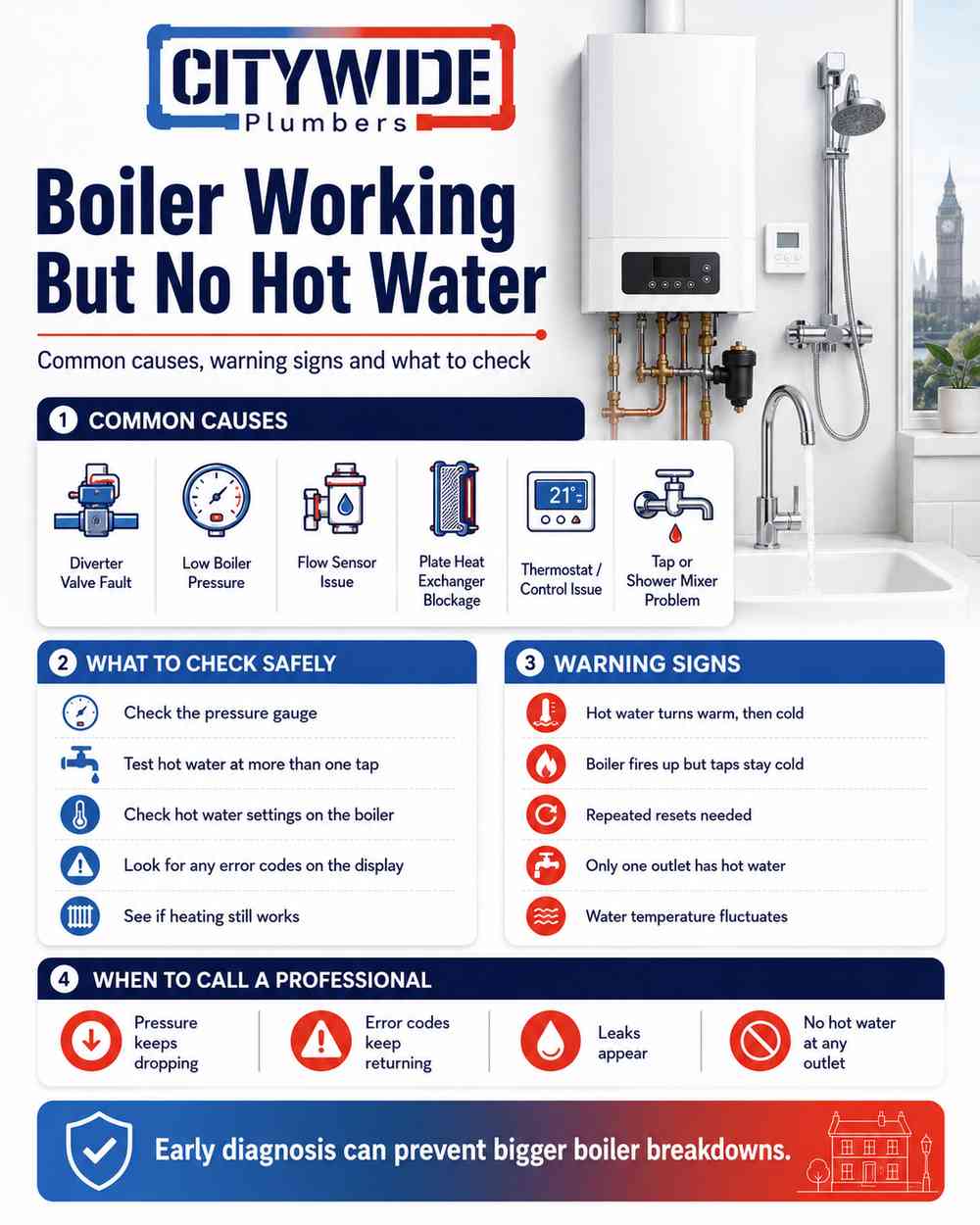 Click the infographic to view it larger
What It Means When the Boiler Works But There Is No Hot Water
When a boiler works for heating but not for hot water, the fault is often linked to the part of the system that switches demand from radiators to taps. In many London homes, this usually means a combi boiler is involved. A combi boiler heats water on demand, so when you open a hot tap, the boiler should recognise the flow and prioritise domestic hot water.
If that process fails, the boiler may still run for heating but not respond correctly to a tap or shower. This does not always mean the boiler is beyond repair. It may be a valve, sensor, plate heat exchanger, flow issue, control setting or pressure-related fault. In some homes, the problem may not be inside the boiler at all and may instead involve taps, shower mixers or pipework.
A useful first step is to identify the pattern. Does every hot tap run cold, or is only one shower affected? Does the boiler fire when a hot tap is opened? Does the heating still work normally? Does the display show a fault code? These details help an engineer diagnose the fault more quickly.
- Heating works but taps stay cold
- Hot water starts warm then quickly runs cold
- Only one outlet or shower is affected
- The boiler does not fire when a tap opens
- The boiler fires but water temperature fluctuates
- Error codes appear when hot water is demanded
Safe Checks Before Calling a Boiler Engineer
Before assuming the worst, there are a few safe external checks you can make without opening the boiler casing. These checks are simple and do not involve working on gas components or internal parts. If anything looks unsafe, smells unusual or involves removing covers, stop and call a qualified professional.
First, check whether the boiler has power and whether the display is active. A switched-off fused spur, tripped circuit or control issue can make the boiler behave unexpectedly. Next, check the pressure gauge. Many boilers work best when system pressure is around the normal operating range shown in the manufacturer’s instructions. If pressure is very low, the boiler may lock out or fail to operate correctly.
Then test more than one hot water outlet. If the kitchen tap runs hot but the shower stays cold, the problem may be the shower valve rather than the boiler. If every outlet is cold, the boiler or hot water circuit is more likely to be involved. Also check whether your thermostat, programmer or smart control is set correctly, especially after a power cut or recent setting change.
- Check the boiler display and power supply
- Look for visible error codes
- Check the boiler pressure gauge
- Try more than one hot water tap
- Confirm heating and hot water settings
- Avoid opening the boiler casing yourself
Low Pressure and Boiler Lockout
Low pressure is a common reason for boiler problems. In some cases, the heating may appear to work for a while, but the boiler may still behave unpredictably when hot water is demanded. If pressure drops below the correct range, the boiler may stop operating, show a fault code or enter a lockout condition to protect itself.
Pressure loss may happen after bleeding radiators, from a small leak, due to a faulty pressure relief valve or because of an expansion vessel issue. If you repressurise the boiler and the pressure drops again, the cause needs to be found. Continually topping up pressure without solving the underlying issue can lead to further faults and may introduce fresh oxygen into the system, which can encourage corrosion over time.
For a property in Fulham, pressure problems may be more common in older heating systems, converted flats or homes where radiators and pipework have been modified over the years. A professional Boiler Service in Fulham can help identify pressure-related issues, visible leaks, worn components and system condition before a small fault becomes a more inconvenient breakdown.
If the pressure is low and you know how to top it up safely according to your boiler instructions, this may restore temporary operation. However, if pressure loss returns, if the boiler displays repeated errors or if there are signs of leaking, arrange a professional inspection.
Combi Boiler Diverter Valve Problems
One of the most common reasons a combi boiler provides heating but no hot water is a diverter valve fault. The diverter valve directs heat either to the radiators or to the domestic hot water system. When you open a hot tap, the boiler should prioritise hot water. If the valve sticks, fails or moves incorrectly, hot water may not be produced properly.
A faulty diverter valve can create several symptoms. You may find that radiators warm up when you run a hot tap, the hot water only becomes lukewarm, or the water temperature keeps changing. In some cases, heating works perfectly, but the taps remain cold because the boiler is not switching into hot water mode as it should.
Diverter valve problems usually need an engineer because the part sits inside the boiler and should not be handled by the homeowner. The engineer may test the valve, check whether it is sticking, inspect related components and confirm whether repair or replacement is needed. Sometimes symptoms that look like a diverter valve fault may actually be caused by a sensor, PCB or flow issue, so proper diagnosis matters.
Replacing the wrong part can waste money and still leave you without hot water. A qualified diagnosis helps avoid guesswork and ensures that the actual cause is treated safely.
Hot Water Flow, Sensors and Plate Heat Exchanger Issues
A combi boiler needs to detect water flow when a hot tap is opened. If the boiler cannot sense the flow correctly, it may not fire for hot water. This can happen because of a faulty flow sensor, blocked filter, scale build-up, restricted pipework or an issue with the internal hot water components.
The plate heat exchanger is another important part. It transfers heat from the boiler circuit to the domestic hot water. If it becomes blocked or restricted by scale, sludge or debris, the boiler may run but hot water may be weak, inconsistent or only lukewarm. In some London homes, hard water and older heating systems can make build-up more likely over time.
Flow-related faults can also appear at taps and showers. A mixer shower cartridge, thermostatic valve or tap fault can prevent hot water from coming through one outlet while other taps work normally. This is why testing different outlets is useful. If only one shower is affected, the boiler may not be the main problem.
- Hot water may be lukewarm rather than fully cold
- Temperature may rise and fall during a shower
- The boiler may not recognise hot water demand
- Only one tap or shower may be affected
- Scale or sludge can restrict heat transfer
- Internal sensors should be tested by an engineer
Thermostat, Timer and Control Issues
Sometimes the boiler is not the problem. Controls can cause confusion, especially where a home has a programmer, room thermostat, smart thermostat, wireless receiver or separate hot water schedule. After a power cut, battery failure or accidental setting change, the system may not behave as expected.
For combi boilers, hot water is usually supplied on demand, but settings can still affect operation depending on the boiler and control system. For homes with a cylinder, the hot water may depend on a separate timer, cylinder thermostat or motorised valve. If the heating works but stored hot water does not, the fault may involve the cylinder controls rather than the boiler itself.
Check whether the control is calling for heat, whether the batteries are working and whether the boiler is in the correct mode. Some boilers have summer mode, comfort mode, eco mode or preheat settings that can change how hot water is delivered. These settings vary by model, so the manufacturer’s instructions are the best reference for basic user checks.
If controls seem to be communicating incorrectly with the boiler, an engineer can test the programmer, thermostat, receiver, wiring centre and valves. Control faults can look like boiler faults, so it is important to check the system as a whole.
Airlocks, Pipework and Tap Problems
Not every hot water problem begins inside the boiler. Pipework, taps, shower valves and airlocks can also affect hot water delivery. This is especially true in older London properties, converted buildings or homes where plumbing has been altered over time.
If only one tap or shower is affected, the issue may be local. A blocked tap filter, faulty mixer cartridge, thermostatic shower valve or restricted pipe can prevent hot water from passing properly. In some cases, cold water may overpower the hot supply at a mixer, making it feel as though the boiler is not heating water.
Airlocks can also interrupt flow. They are more common in some traditional systems than in modern combi setups, but they can still happen after plumbing work, drained systems or changes to pipework. Symptoms can include spluttering taps, uneven flow or hot water failing to reach a particular outlet.
A plumber can test whether hot water is leaving the boiler correctly and whether the problem starts further along the pipework. This is useful because it separates boiler faults from outlet faults and helps prevent unnecessary boiler repairs.
Error Codes and Repeated Boiler Resets
Modern boilers use error codes to help identify a fault area. If the boiler is working for heating but not for hot water, the display may show a code linked to pressure, ignition, temperature, sensors, flow, pump operation or internal communication. The exact meaning depends on the boiler model.
It is sensible to write down the error code before resetting the boiler. If the same code returns, the issue needs diagnosis. Repeatedly resetting the boiler may clear the display temporarily, but it does not fix the fault. It can also make it harder to understand what triggered the problem in the first place.
If the boiler locks out only when hot water is used, the engineer will want to know that. If it locks out during both heating and hot water, the cause may be wider. Details such as when the fault happens, whether the boiler fires, how long the water stays warm and whether radiators heat at the wrong time can all help speed up diagnosis.
| Symptom |
Possible Cause |
Recommended Action |
| Heating works, taps stay cold |
Diverter valve, flow sensor or hot water circuit fault |
Arrange boiler diagnosis |
| Hot water goes warm then cold |
Scale, plate heat exchanger issue or sensor fault |
Book a professional inspection |
| Only one shower is cold |
Shower mixer, cartridge or local pipework issue |
Check other taps and call a plumber |
| Boiler shows pressure fault |
Low pressure, leak or expansion vessel issue |
Check pressure and arrange repair if it returns |
| Repeated lockouts |
Ignition, sensor, pump, flow or safety fault |
Avoid repeated resets and call an engineer |
Safety Signs You Should Not Ignore
Hot water failure is inconvenient, but safety must come first. You should never remove the boiler casing, adjust gas components or attempt internal boiler repairs yourself. Gas boiler work should only be carried out by a suitably qualified Gas Safe registered engineer.
There are also warning signs that need urgent attention. These include a gas smell, soot marks around the boiler, a yellow or unstable flame on older appliances, signs of scorching, water leaking into electrical areas, repeated lockouts or carbon monoxide alarm activation. If you suspect a gas leak or carbon monoxide problem, follow emergency safety guidance immediately and do not continue using the appliance.
A leaking boiler should also be treated carefully. Small drips can damage pressure, electrics, components and surrounding property. If water is coming from the boiler or nearby pipework, switch off safely where appropriate and arrange professional help. Do not ignore leaks because they rarely improve on their own.
- Do not remove the boiler casing
- Do not attempt gas or internal boiler repairs
- Act quickly if you smell gas
- Take carbon monoxide alarms seriously
- Do not ignore water near boiler electrics
- Call a qualified engineer for safety concerns
Service, Repair or Replacement?
When a boiler works but no hot water is available, the right solution depends on the diagnosis. A simple control issue may only need adjustment. A low-pressure fault may need the leak or pressure component found. A diverter valve, flow sensor or heat exchanger issue may require repair or part replacement. In older boilers, repeated hot water faults may lead to a discussion about replacement.
A boiler service is useful for checking condition, safety, visible leaks, combustion, ventilation and performance. However, an active hot water fault may need a separate repair diagnosis as well as routine servicing. If your boiler has not been serviced recently, combining maintenance with fault investigation may help identify wider issues.
Landlords should also remember that rented homes have formal gas safety responsibilities. Regular checks and proper maintenance protect tenants and reduce the risk of heating and hot water failures during colder months.
For homeowners and landlords who need Expert Boiler Installation, Repairs & Servicing in Fulham, the best approach is to deal with the fault early. Waiting too long can make a small issue more disruptive, especially when the boiler is relied on for daily showers and household hot water.
If your boiler is working but no hot water is coming through, do not keep resetting it or guessing which part has failed. Testing the full system properly is the safest way to find the cause. With support from Citywide Plumbers, you can restore hot water, protect your heating system and reduce the chance of repeat breakdowns in your London or Fulham property.
Boiler Working But No Hot Water?
Citywide Plumbers provides professional boiler servicing, boiler repairs, hot water fault diagnosis and heating support for homes and landlords in Fulham and across London.
If your taps are cold but the boiler appears to be running, arrange a proper inspection before the problem becomes more disruptive.
Book Boiler Support