Boilers work hard in London homes, especially through cold mornings, damp evenings and long heating seasons. When they begin to lose pressure, make unusual noises, leak water or stop heating properly, it can quickly affect comfort, hot water and daily routines. For homeowners and landlords who want dependable help from Citywide Plumbers, understanding the most common boiler problems is the first step towards safer, faster and more cost-effective repairs.
Many boiler faults start small. A radiator may feel slightly cooler at the top, the pressure gauge may drop slowly, or the boiler may need resetting more often than usual. These issues are easy to ignore, but in many homes they can develop into larger heating problems if the cause is not checked properly. London properties can also have older pipework, compact boiler cupboards, hard-working combi boilers and heating systems that have been altered over several years, making proper diagnosis even more important.
This guide explains the most common boiler problems in London homes, what warning signs to look for, when a simple check may be enough and when it is safer to call a qualified professional. It also covers how regular servicing can help reduce breakdowns, improve reliability and keep your heating system working properly throughout the year.
Boiler Problems Infographic
This visual guide highlights the most common boiler problems in London homes, including pressure loss, leaks, heating faults, warning signs and when professional support may be needed.
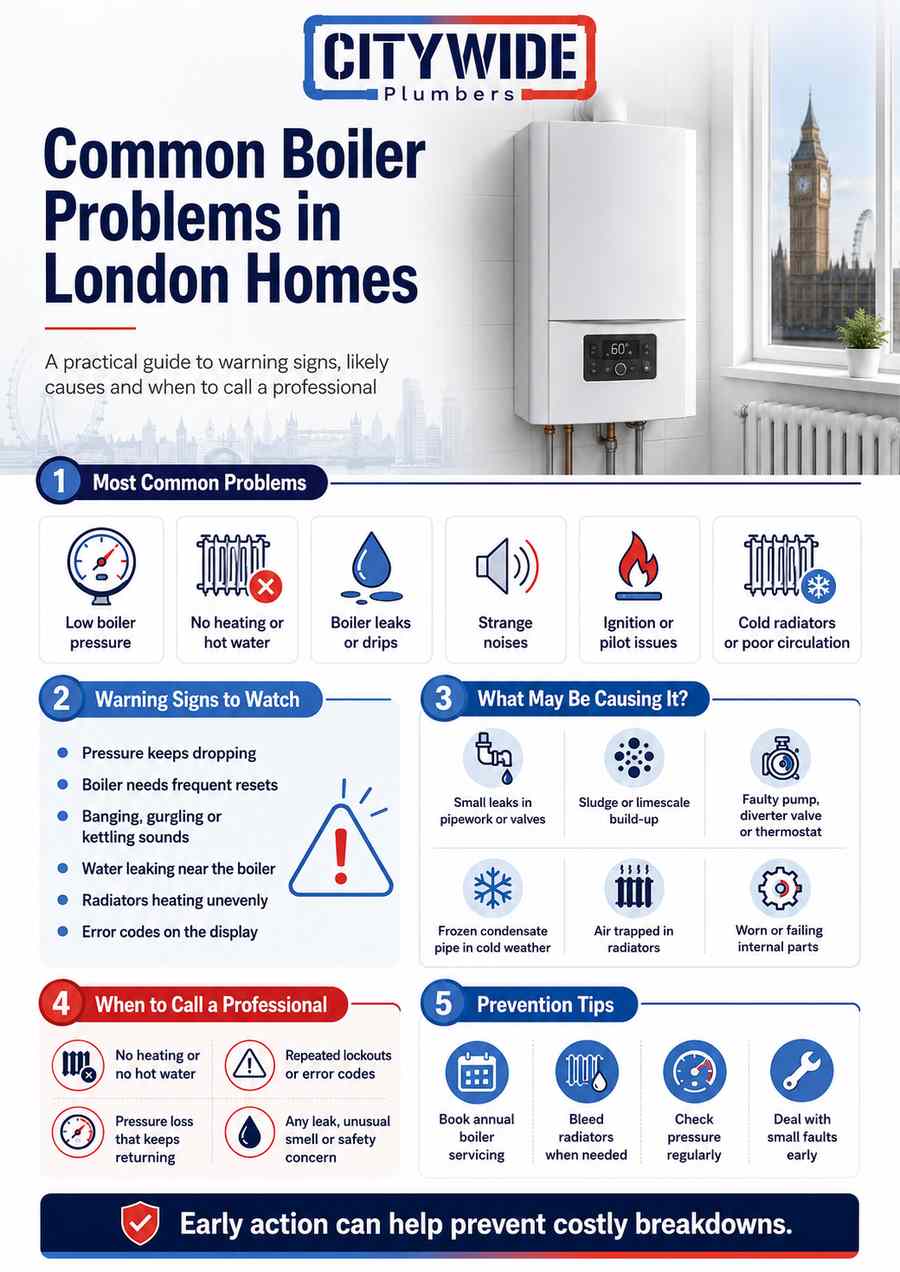 Click the infographic to view it larger
Why Boiler Problems Are Common in London Homes
London homes often place heavy demand on their boilers. Many properties are older, space can be limited, and heating systems may have been extended, repaired or upgraded at different stages. In Fulham and nearby areas, it is common to find a mixture of period homes, converted flats, rental properties and modern apartments, each with different heating requirements and installation conditions.
A boiler fault does not always mean the boiler itself has completely failed. The issue may be connected to pressure, pipework, radiators, thermostats, valves, pumps, wiring, sludge, air in the system or external controls. This is why guessing the cause can lead to repeated problems. A professional inspection looks at the full heating system, not just the boiler casing.
Common early warning signs include pressure loss, unusual noises, intermittent hot water, cold radiators, repeated resets, small leaks, higher energy use or the boiler taking longer to heat the home. If these signs appear regularly, it is usually better to arrange an assessment before the fault becomes more disruptive.
- Older pipework can affect system pressure and circulation
- Converted flats may have compact or restricted boiler locations
- Hard-working combi boilers can show wear during colder months
- Radiator sludge can reduce heating efficiency
- Thermostat and control faults can mimic boiler failure
- Small leaks can slowly damage pressure and performance
Low Boiler Pressure
Low boiler pressure is one of the most common issues homeowners notice. Most boilers have a pressure gauge or digital display, and when the pressure falls too low, the boiler may stop operating correctly. This can result in no heating, no hot water, poor radiator performance or a fault code appearing on the screen.
Pressure can drop for several reasons. A small leak in the heating system, recently bled radiators, a faulty pressure relief valve or an issue with the expansion vessel can all cause pressure loss. Sometimes a homeowner may top up the pressure and the boiler works again for a short time, but if it keeps dropping, there is usually an underlying problem that needs attention.
London homes with older radiators or long pipe runs may be more likely to suffer from hidden leaks or gradual pressure loss. Even a small drip from a radiator valve, pipe joint or boiler component can reduce pressure over time. Repressurising again and again without finding the cause can put extra strain on the system.
If the pressure drops once after radiator bleeding, it may be straightforward to correct. If it keeps happening, the safer approach is to arrange a professional check. A qualified engineer can inspect the boiler, visible pipework, radiators and valves to identify whether the issue is a leak, faulty part or pressure-related component.
No Heating or No Hot Water
A boiler that provides no heating, no hot water or only works intermittently can be frustrating, especially in a busy London household. With combi boilers, hot water and central heating are both supplied from the same unit, so one fault can affect the whole home. In other systems, the issue may involve the cylinder, programmer, motorised valve or thermostat.
The cause could be simple, such as low pressure, a thermostat setting, a tripped switch or a timer issue. However, it could also involve internal components such as the pump, diverter valve, fan, heat exchanger, ignition system or PCB. If the boiler starts and then quickly stops, displays an error code, or repeatedly needs resetting, it should not be ignored.
For homes in Fulham, where many properties rely on a boiler for both daily hot water and heating, fast diagnosis is important. A clear fault assessment helps avoid replacing parts unnecessarily and ensures the correct repair is carried out. If your boiler has become unreliable, a professional Boiler Service in Fulham can also help identify wear, safety concerns and maintenance issues before they become major breakdowns.
- Check the thermostat and programmer settings first
- Look for error codes on the boiler display
- Check whether pressure has dropped too low
- Notice whether hot water or heating is affected separately
- Avoid repeated resets without understanding the fault
- Call a qualified engineer if the issue returns
Boiler Leaks and Drips
A boiler leak should always be taken seriously. Even a small drip can point to a damaged seal, loose joint, pressure problem, corroded pipe, faulty valve or internal component issue. Water and boiler electrics do not mix, so leaks should be checked quickly rather than left to continue.
Leaks can appear underneath the boiler, around pipe connections, near radiator valves or from the pressure relief pipe outside. The location of the leak can help indicate the cause, but it is not always obvious without inspection. A leak may also reduce pressure, cause error codes or stop the heating from working properly.
Corrosion is another concern. If parts inside the boiler or surrounding pipework begin to corrode, the problem can become more expensive over time. London homes with older heating systems may also contain sludge or dirty system water, which can affect pumps, valves and heat exchangers. Treating the symptom without dealing with the system condition can allow the same problem to return.
If you notice a leak, switch off the boiler if it is safe to do so, avoid touching electrical parts and call for professional help. Do not remove the boiler casing or attempt internal repairs yourself. Gas boiler work should only be carried out by a suitably qualified Gas Safe registered engineer.
Strange Boiler Noises
Boilers are not silent, but sudden banging, whistling, gurgling, vibrating or kettling noises should not be ignored. Unusual sounds can suggest trapped air, low pressure, pump problems, limescale, sludge, poor circulation or overheating inside the system. The type of noise and when it happens can help narrow down the cause.
Kettling is a common concern. It can sound like a kettle boiling and may be linked to restricted water flow through the heat exchanger. This can happen when limescale or sludge builds up inside the system. In areas with hard water, boilers and heating systems may be more vulnerable to scale-related issues if maintenance is neglected.
Gurgling noises can point to air in the radiators or pipework. Banging sounds may suggest pressure changes, circulation problems or components struggling to operate correctly. Vibrations may come from loose panels, pump issues or pipe movement. While some noises may have simple explanations, persistent or worsening sounds should be checked.
Regular servicing and system maintenance can help reduce the risk of noise-related faults. A heating engineer can check pressure, circulation, pump performance, radiator balance and signs of internal build-up. If the system water is dirty, further cleaning or treatment may be recommended to improve long-term performance.
Pilot Light and Ignition Problems
Older boilers may use a pilot light, while many modern boilers use electronic ignition. If the pilot light keeps going out, the boiler fails to ignite or the ignition sequence stops repeatedly, the fault should be checked by a professional. Ignition problems can involve gas supply, electrodes, sensors, fans, flues, valves or safety devices.
A boiler is designed to shut down when it detects a fault or unsafe operating condition. This is an important safety feature, not just an inconvenience. If the boiler locks out, shows an ignition error or refuses to stay on, repeatedly pressing reset is not a proper solution. It may briefly restore operation, but it will not fix the cause.
Warning signs around combustion safety should never be ignored. These may include soot marks, unusual smells, a yellow or unstable flame on older appliances, repeated pilot failure or symptoms that could be linked to carbon monoxide exposure. If you suspect a gas leak or carbon monoxide issue, leave the property, seek urgent help and follow official gas emergency guidance.
For routine ignition faults, book a qualified boiler engineer. They can safely test the appliance, inspect relevant components and confirm whether repair, servicing or part replacement is needed.
Radiator and Circulation Issues
Sometimes the boiler is working, but the home still does not heat properly. Cold radiators, uneven heat, noisy pipework or slow warm-up times can point to circulation problems. The issue may be air in the radiators, sludge in the system, poor balancing, a weak pump, stuck valves or incorrect heating controls.
If the top of a radiator is cold while the bottom is warm, trapped air may be the problem. If the bottom of the radiator is cold, sludge or poor circulation may be involved. If only one radiator is affected, the issue may be local to that radiator or valve. If many radiators are affected, the wider heating system may need attention.
London homes often have heating systems that have been modified over time. Additional radiators, changed pipe routes, extensions or converted layouts can affect how heat moves through the property. Balancing the radiators and checking the pump can make a noticeable difference to comfort and efficiency.
A professional engineer can assess whether the issue is simple radiator bleeding, valve adjustment, system balancing, power flushing, pump repair or boiler-related. The key is to avoid assuming every cold radiator means the boiler has failed. In many cases, the boiler is only one part of a wider heating system problem.
Frozen Condensate Pipes
Condensing boilers produce condensate, which usually drains through a plastic pipe. In cold weather, external condensate pipes can freeze, causing the boiler to shut down. This is especially common when the pipe runs outside, is poorly insulated or has a long exposed section.
When a condensate pipe freezes, the boiler may make gurgling sounds, display a fault code or stop working completely. Some homeowners notice the problem during sudden cold snaps because the heating is needed most at the exact time the pipe becomes blocked. Modern boilers are designed to stop operating when condensate cannot drain correctly.
In some cases, a frozen condensate pipe can be thawed safely using warm water, but boiling water should not be used because it can damage the pipe or cause injury. If you are unsure where the pipe is, cannot access it safely or the boiler still does not restart, it is better to call a professional.
Prevention matters. Proper insulation, improved pipe routing and correct installation can reduce the chance of repeat freezing. If the same condensate problem happens every winter, the pipework may need to be reviewed rather than temporarily thawed each time.
Boiler Error Codes and Repeated Resets
Error codes are useful because they give an indication of what the boiler has detected. However, they do not always provide the full diagnosis. A code may point towards ignition failure, low pressure, fan problems, pump faults, temperature issues, sensor faults or communication problems with controls.
It is sensible to note the error code before resetting the boiler. If the code disappears, the engineer may have less information to work with. If the same code returns, that is a clear sign the problem needs investigation. Repeated resets can mask a fault temporarily and may place unnecessary strain on the boiler.
Homeowners should also be careful with online fault-code advice. While it can help you understand what the code may relate to, it cannot confirm the exact cause in your property. Boilers from different manufacturers use different codes, and one code can have several possible explanations depending on the model and system condition.
| Warning Sign |
Possible Cause |
Best Next Step |
| Pressure keeps dropping |
Leak, valve issue or expansion vessel fault |
Book a professional pressure and leak check |
| No heating or hot water |
Low pressure, diverter valve, pump, ignition or control fault |
Check display codes and arrange diagnosis |
| Banging or kettling sounds |
Sludge, scale, air or circulation restriction |
Have the system inspected and maintained |
| Water dripping from boiler |
Seal, pipe, valve, corrosion or pressure issue |
Turn off safely and call an engineer |
| Boiler keeps locking out |
Ignition, gas supply, flue, sensor or safety fault |
Avoid repeated resets and book a repair |
If your boiler regularly shows error codes, locks out or needs resetting, arrange a proper inspection. The aim is not only to clear the code, but to understand why the boiler is protecting itself from continued operation.
When to Book a Boiler Service
A boiler service is not only for when something has already gone wrong. Regular servicing helps check safety, performance, combustion, ventilation, seals, controls and visible signs of wear. It can also help identify developing problems before they turn into inconvenient breakdowns.
Many homeowners book a service once a year, particularly before the colder months. Annual servicing is often recommended to support safe operation, maintain performance and help protect manufacturer warranty requirements. Landlords also have legal responsibilities for gas safety checks in rented properties, so regular professional inspection is especially important in rental homes.
During a service, the engineer may check the boiler condition, clean key parts where appropriate, inspect the flue, test safety devices, review operation and look for warning signs such as leaks, corrosion, poor combustion or restricted ventilation. The exact checks depend on the boiler type, age, manufacturer instructions and system condition.
If you have noticed pressure loss, strange noises, unreliable hot water, poor heating, leaks or repeated error codes, do not wait for the next routine service. Book an inspection sooner. A service is best for maintenance, while an active fault may require diagnosis and repair.
For homeowners and landlords who need Expert Boiler Installation, Repairs & Servicing in Fulham, choosing an experienced local team can make the process simpler. Local knowledge matters because London homes often have different boiler locations, access restrictions, system ages and heating demands.
Whether your boiler needs a routine service, a fault check, repair advice or a wider heating system assessment, working with Citywide Plumbers helps you deal with common boiler problems before they become bigger, more stressful and more expensive.
Need Help with a Boiler Problem in Fulham?
Citywide Plumbers provides professional boiler servicing, boiler repairs, heating support and plumbing services for homes and landlords in Fulham and across London.
If your boiler is losing pressure, making unusual noises, leaking, showing error codes or failing to heat your home properly, arrange a professional check before the problem gets worse.
Book Boiler Support