If your heating is on but your radiators are cold, it can quickly become frustrating, especially during winter in Fulham and West London. The boiler may appear to be working, the programmer may be calling for heat, and the thermostat may be turned up, yet one radiator, several radiators or the whole heating system may still fail to warm properly. For homeowners and landlords who need reliable help from Citywide Plumbers, understanding the possible causes can make it easier to decide whether the issue is a simple radiator problem or a wider central heating fault.
Cold radiators do not always mean your boiler has completely failed. In many homes, the cause is trapped air, low system pressure, a stuck thermostatic radiator valve, sludge build-up, an unbalanced heating system, closed valves or poor circulation. Sometimes the fault is local to one radiator; in other cases, the entire heating circuit may need professional diagnosis.
This guide explains why radiators stay cold when the heating is on, how to read the pattern of cold spots, which checks are safe for homeowners, and when it is better to call a qualified heating engineer. It is written for homes across London and Fulham, where older pipework, converted flats, hard water, compact heating layouts and busy rental properties can all create radiator performance issues.
Important: You can safely check room settings, radiator valves, cold spots and boiler pressure, but you should not open the boiler casing or attempt internal gas appliance repairs. Gas-related work must be handled by a suitably qualified professional.
Heating On But Radiators Cold Infographic
This quick visual guide explains the most common causes of cold radiators, what cold spots may mean, safe checks you can make and when to call a heating engineer.
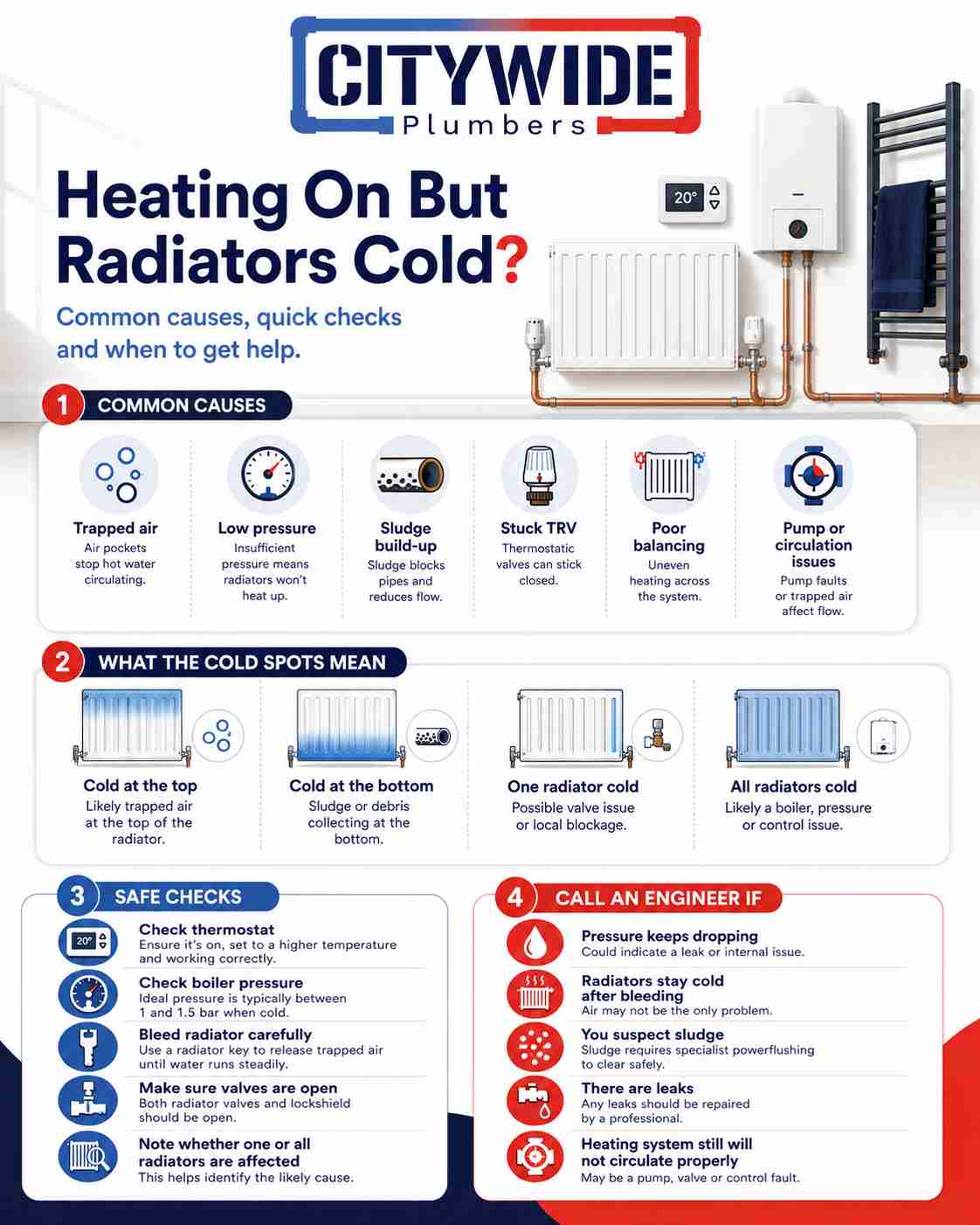
Click the infographic to enlarge
Why Are My Radiators Cold When the Heating Is On?
When the heating is on but radiators remain cold, the first step is to identify whether the problem affects one radiator, a few radiators or every radiator in the property. This pattern tells you a lot about the likely cause. One cold radiator usually points to a local issue such as a closed valve, trapped air, a stuck thermostatic radiator valve or a blockage in that radiator. Several cold radiators may suggest balancing or circulation problems. All radiators staying cold can point to boiler settings, low pressure, a pump fault, controls, a diverter valve issue or a wider heating system failure.
Radiators depend on hot water circulating from the boiler through pipework and back again. If that movement is restricted, the radiator cannot heat properly. Air pockets stop water from filling the radiator fully. Sludge can block the bottom channels. Stuck valves can prevent flow. Low pressure can reduce circulation. A heating system that is not balanced may send more hot water to the nearest radiators while leaving distant rooms cold.
The good news is that many radiator problems can be diagnosed by observing symptoms. Where the radiator is cold, how quickly it heats, whether nearby radiators are working, and whether the boiler pressure is normal all help narrow down the issue.
- One cold radiator usually suggests a local issue
- Cold tops often point to trapped air
- Cold bottoms may suggest sludge build-up
- Several cold radiators can mean poor circulation
- All radiators cold may involve boiler or controls
- Repeated issues should be professionally checked
Radiator Cold at the Top but Warm at the Bottom
A radiator that is warm at the bottom but cold at the top usually has trapped air inside it. Air rises to the highest part of the radiator and stops hot water filling the full panel. This creates a cold top section even though the lower part may still heat.
Trapped air can enter a heating system over time, especially after maintenance, pressure changes, refilling, leaks or long periods without use. In many cases, bleeding the radiator releases the air and allows hot water to circulate properly again. However, it is important to do this safely and to check boiler pressure afterwards, because bleeding can reduce system pressure.
If the same radiator keeps collecting air, or if you need to bleed radiators frequently, the problem may not be solved by simple bleeding alone. Repeated air in the system can suggest pressure loss, a small leak, poor system design or another issue that needs investigation.
- Cold at the top often means trapped air
- Bleeding may restore full heat output
- Pressure should be checked after bleeding
- Repeated air can suggest a deeper fault
- Do not force a damaged bleed valve
- Leaks or pressure loss need inspection
Radiator Cold at the Bottom but Warm at the Top
A radiator that is warm at the top but cold at the bottom often points to sludge or debris collecting inside the lower channels. Central heating sludge is usually made from corrosion particles, dirt and magnetite that build up as water moves through radiators and pipework over time.
Because sludge tends to settle at the bottom, it can block water flow through the lower part of the radiator. The top may still become warm, but the room will not heat efficiently. You may also notice that the radiator takes much longer to warm up, has uneven heat across the surface, or produces dark water when bled.
Sludge can affect more than one radiator. If left untreated, it can reduce system efficiency, put extra strain on the pump, create boiler noise, damage components and increase heating costs. In some cases, the solution may involve removing and flushing a radiator, adding chemical cleaner, fitting a magnetic filter or carrying out a professional power flush.
- Cold at the bottom often suggests sludge
- Sludge can block radiator water flow
- Dark water may appear during bleeding
- Several affected radiators need diagnosis
- Filters and inhibitor can help protection
- Power flushing may be needed in severe cases
Why Is Only One Radiator Cold?
If only one radiator is cold while the others heat normally, the issue is usually local to that radiator rather than a complete boiler failure. The most common causes are trapped air, a closed valve, a stuck thermostatic radiator valve, a blocked pipe connection or a build-up of sludge inside that radiator.
Start by checking both radiator valves. One side may have a thermostatic radiator valve, often marked with numbers, and the other side may have a lockshield valve. If the TRV is set too low or stuck shut, hot water may not enter the radiator. If the lockshield valve has been closed, flow may also be restricted.
A stuck TRV pin is a common issue after warmer months when heating has not been used regularly. The valve head may turn, but the small pin underneath may remain stuck down, preventing water flow.
- Check the TRV setting first
- Make sure both radiator valves are open
- Cold top may mean trapped air
- Cold bottom may mean sludge
- A stuck valve can stop hot water flow
- A fully cold radiator may need repair
Why Are All Radiators Cold but Hot Water Works?
If all radiators are cold but hot water still works, the fault may be connected to heating controls, the diverter valve, the circulation pump, programmer settings, room thermostat settings or central heating pipework. In a combi boiler system, the boiler can sometimes provide hot water to taps while failing to send heat around the radiators.
First, check that the heating mode is selected, the programmer is on, the room thermostat is calling for heat and the temperature settings are sensible. Sometimes a simple control setting can make it look as though the heating has failed.
If the controls are correct but radiators remain cold, there may be a mechanical or electrical fault. A diverter valve may be stuck, the pump may not be moving water, or the boiler may not be responding correctly to heating demand. This type of issue normally needs a professional heating engineer.
Could Low Boiler Pressure Make Radiators Cold?
Low boiler pressure is a common reason for poor radiator performance in sealed central heating systems. If the pressure is too low, the boiler may struggle to circulate water properly or may stop operating for heating altogether. Some boilers will show a fault code when pressure drops below the safe operating range.
Most systems have a pressure gauge on the boiler or nearby pipework. The correct pressure can vary by manufacturer, but many domestic systems sit around the typical recommended range when cold. If the pressure is too low, the system may need topping up through the filling loop. However, topping up should not become a regular routine without finding the cause of pressure loss.
Pressure can drop after bleeding radiators, after a leak, due to a faulty pressure relief valve, or because of an expansion vessel issue. If pressure falls again soon after topping up, there is likely an underlying fault that should be investigated.
- Low pressure can stop proper circulation
- Bleeding radiators can reduce pressure
- Repeated pressure loss may indicate a leak
- Do not overfill the heating system
- Fault codes may appear on some boilers
- Unstable pressure needs professional diagnosis
Thermostatic Radiator Valves and Closed Valve Problems
Thermostatic radiator valves, often called TRVs, control how much hot water enters a radiator based on the room temperature setting. They are useful for comfort and efficiency, but they can also cause confusion when radiators stay cold.
If a TRV is turned down, the radiator may not heat because the room has already reached the selected setting or because the valve is restricting flow. In colder weather, it is worth checking that the TRV is not set to frost protection or a very low number.
TRVs can also stick, particularly after summer when they have not moved for months. The control head may appear to turn normally while the pin inside remains stuck. This prevents hot water from entering the radiator even when the heating is on.
- TRVs may be set too low
- Valve pins can stick after summer
- Lockshield valves can restrict flow
- Closed valves can make one radiator cold
- Forcing valves may cause leaks
- Faulty valves may need replacement
Does the Heating System Need Balancing?
If some radiators heat quickly while others stay lukewarm or cold, the system may need balancing. Balancing controls how water flows through each radiator, helping the whole property heat more evenly. Without balancing, radiators closest to the boiler may take most of the hot water while distant radiators receive very little flow.
This is common in larger homes, extended properties, multi-storey houses and older London heating systems. It can also happen after radiators are replaced, towel rails are added, valves are changed or pipework is altered.
Balancing usually involves adjusting lockshield valves so that every radiator receives the right amount of flow. Done properly, balancing can improve comfort, reduce cold rooms and help the boiler work more efficiently.
| Symptom |
Possible Cause |
Likely Next Step |
| Cold at the top |
Trapped air inside radiator |
Bleed radiator and check pressure |
| Cold at the bottom |
Sludge or debris build-up |
System cleaning or radiator flushing |
| One radiator cold |
Closed valve, stuck TRV, air or blockage |
Check valves, bleed, inspect flow |
| Radiators heat unevenly |
System not balanced |
Balance lockshield valves |
| All radiators cold |
Boiler, controls, pump or pressure issue |
Arrange heating fault diagnosis |
Safe Checks Before Calling a Heating Engineer
There are a few sensible checks you can make before booking a repair. These may help you describe the issue clearly and may also solve minor radiator problems without unnecessary disruption.
Check the thermostat, programmer and heating schedule first. Make sure the heating is actually calling for heat. Then check the boiler pressure when the system is cool. Look at each radiator and note whether it is cold at the top, bottom or all over. Check that TRVs are not turned down and that visible valves are open.
If you bleed a radiator, keep a towel ready, release air slowly and close the valve as soon as water appears. After bleeding, check the boiler pressure again. You should also watch for signs that the problem is more serious, including leaks, repeated pressure loss, noisy pumps, boiler fault codes or dark water during bleeding.
- Check the thermostat and timer settings
- Look at boiler pressure when cool
- Feel where each radiator is cold
- Check TRV and valve positions
- Bleed radiators carefully if needed
- Note fault codes before resetting the boiler
When Should You Call a Professional?
You should call a heating engineer if all radiators are cold, pressure keeps dropping, a radiator stays cold after bleeding, valves are stuck, there are leaks, the boiler shows a fault code, or the same problem keeps returning. You should also arrange professional support if you suspect sludge, poor circulation, a pump problem, a diverter valve fault or a heating system that needs balancing.
For homeowners and landlords in West London, professional radiator and towel rail work can include diagnosis, bleeding, valve replacement, TRV repair, radiator replacement, towel rail installation, leak repairs, pipework alterations, balancing, flushing and system performance checks.
If your radiator issue is linked to a wider heating problem, it may also be the right time to review your controls, boiler performance, water treatment and maintenance schedule. Citywide Plumbers provides RADIATORS AND TOWEL RAILS SERVICES IN WEST LONDON for homes, flats and rental properties that need reliable radiator repairs, replacements and heating improvements.
Radiators, Towel Rails and Heating Comfort in West London Homes
Radiators and towel rails are not just functional parts of a heating system; they directly affect comfort, efficiency and the way a room feels. A poorly performing radiator can leave one room cold even when the rest of the home feels warm. A towel rail that does not heat properly can make bathrooms uncomfortable and may indicate flow, valve or balancing problems.
In Fulham and West London properties, radiator issues are often connected to older layouts, compact pipe routes, property renovations, mixed radiator ages and systems that have been extended over time. When new radiators or towel rails are added without proper balancing, some rooms may stop heating as well as they should.
Professional support helps ensure that repairs do not only fix the immediate symptom but also improve the wider heating system. That may involve checking flow, pressure, valves, pipework, radiator condition and boiler performance together.
Final Thoughts: Do Not Ignore Cold Radiators
Cold radiators are one of the clearest signs that your heating system is not working as it should. The cause might be trapped air, low pressure, sludge, a stuck valve, poor balancing, a faulty pump, boiler controls or a wider circulation issue. The pattern of the problem is the most useful clue: cold at the top, cold at the bottom, one radiator cold, several radiators cold or all radiators cold can each point to different causes.
Simple checks such as reviewing thermostat settings, checking pressure, opening valves and bleeding radiators can help in some cases. However, repeated cold spots, leaks, pressure loss, sludge signs and complete heating failure should not be ignored. Early diagnosis can prevent bigger heating problems and improve comfort across the home.
Whether you need radiator repairs, towel rail installation, valve replacement, heating balancing or wider Heating Services in London, working with Citywide Plumbers can help keep your Fulham or West London heating system warm, reliable and efficient.
Need Help with Cold Radiators in West London?
Citywide Plumbers provides professional radiator repairs, towel rail services, heating fault diagnosis, valve replacement, system balancing and heating support across Fulham and West London.
Book Radiator & Towel Rail Services