Choosing between a conventional boiler and a combi boiler can feel confusing, especially in Fulham properties where space, water pressure, family size and existing pipework all matter. For homeowners comparing repair, servicing or replacement options, Citywide Plumbers provides practical plumbing and heating support for homes across Fulham and London, helping customers understand which boiler setup best suits their property before making a costly decision.
A combi boiler and a conventional boiler can both heat your home, but they work in very different ways. A combi boiler provides heating and hot water from one compact unit, usually without needing a separate hot water cylinder. A conventional boiler, often called a regular or heat-only boiler, usually works with a hot water cylinder and, in many older systems, tanks in the loft.
The right choice depends on how many bathrooms you have, how many people use hot water at the same time, whether you already have a cylinder, how much storage space is available and whether your mains water pressure is strong enough. This guide explains the difference clearly so you can make a better decision for your Fulham home.
Conventional Boiler vs Combi Boiler Infographic
Use this visual guide to quickly compare hot water storage, space requirements, water pressure, installation complexity and the best boiler type for different Fulham homes.
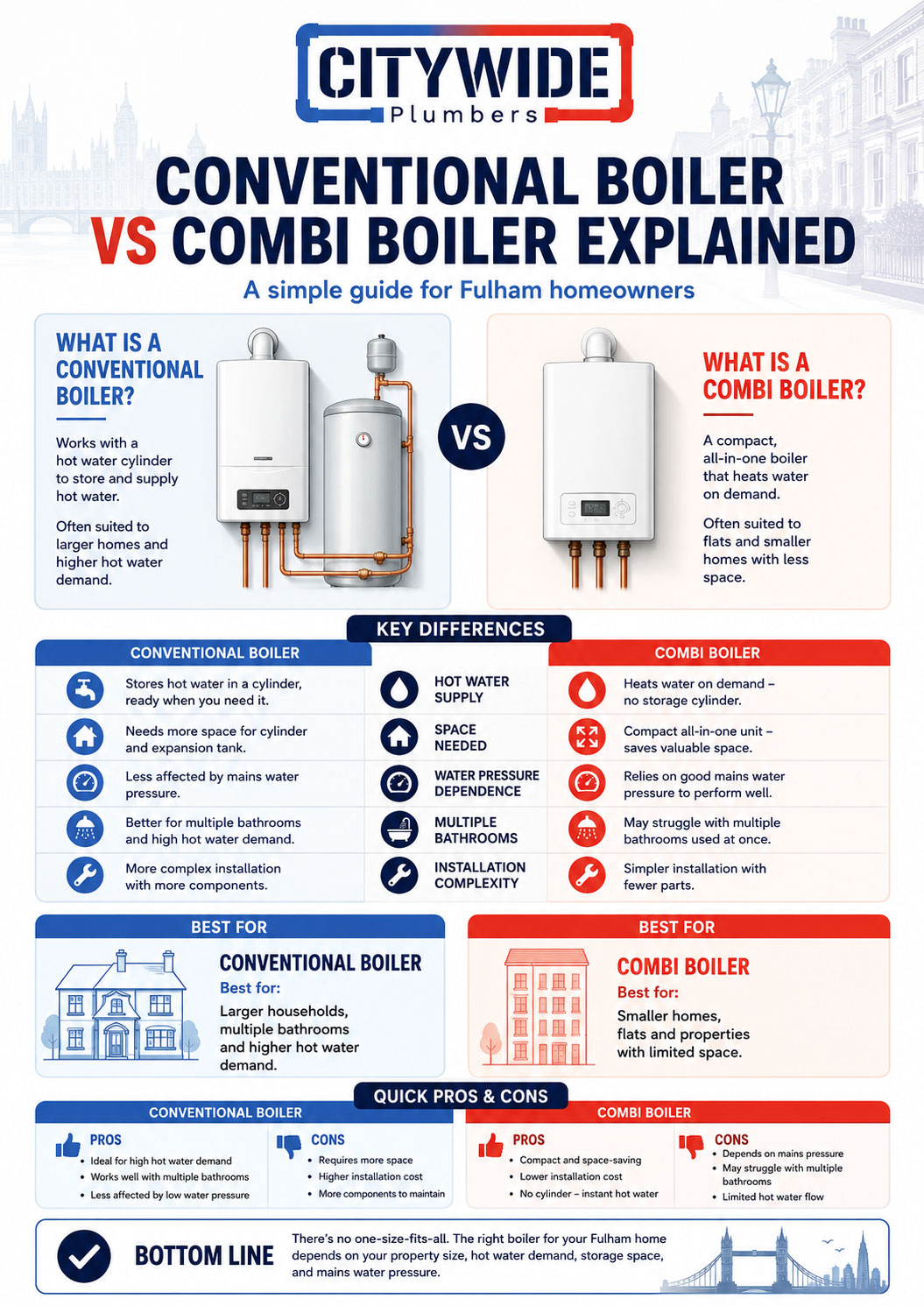 Click the infographic to enlarge
What Is a Conventional Boiler?
A conventional boiler is a traditional heating system that is commonly found in older houses, larger family homes and properties that already have a hot water cylinder. It heats water for your radiators and also supplies hot water to a storage cylinder. When hot water is needed, it is drawn from the cylinder rather than being heated instantly at the tap.
In many older setups, a conventional boiler may also use cold water and feed-and-expansion tanks in the loft. The exact arrangement depends on the age of the system, the property layout and any previous upgrades. This is why a proper site inspection is important before deciding whether to keep, upgrade or replace a conventional system.
The main advantage of a conventional boiler is stored hot water capacity. If several people need showers, baths or hot taps at similar times, a well-sized cylinder can support stronger demand than many combi boilers. This can make conventional systems useful in homes with multiple bathrooms or larger families.
- Often suitable for larger homes with higher hot water demand
- Works with a separate hot water cylinder
- Can support multiple hot water outlets when correctly sized
- May already be installed in older Fulham houses
- Can be practical where existing pipework and tanks are retained
- Usually needs more space than a combi boiler
What Is a Combi Boiler?
A combi boiler, short for combination boiler, provides central heating and hot water from one compact unit. Instead of storing hot water in a cylinder, it heats water directly from the mains when you turn on a hot tap or shower. This makes it a popular choice for flats, smaller homes and properties where cupboard or loft space is limited.
Because a combi boiler does not normally need a hot water cylinder or cold water storage tank, it can free up useful space. This is one reason combi boilers are common in London apartments, converted flats and compact homes where every cupboard matters.
The main limitation is hot water flow. A combi boiler can be excellent for one bathroom or moderate hot water use, but performance may drop if several showers or taps are used at the same time. The final result depends on boiler size, mains flow rate, pipework condition and the number of outlets in the property.
- Compact unit for heating and hot water
- No separate hot water cylinder in most installations
- Good option for flats and smaller homes
- Hot water is heated on demand
- Can reduce storage requirements
- Depends heavily on mains water flow and pressure
Conventional Boiler vs Combi Boiler: Main Differences
The simplest difference is storage. A conventional boiler usually stores hot water in a cylinder, while a combi boiler heats hot water on demand. This one difference affects space, pressure, installation cost, household comfort and how the system behaves when several people use hot water at once.
For example, a two-bedroom flat with one bathroom may not need a large stored hot water system. A combi boiler can be more space-efficient and convenient. In contrast, a family house with two or three bathrooms may benefit from a cylinder because it can provide a reserve of hot water for higher demand.
The existing system also matters. Replacing an old conventional boiler with another compatible boiler can sometimes be simpler than converting the entire system to a combi. However, if the cylinder, tanks and pipework are old or taking up valuable space, switching to a combi may be worth considering.
| Feature |
Conventional Boiler |
Combi Boiler |
| Hot water method |
Stores hot water in a cylinder |
Heats hot water on demand |
| Space required |
More space due to cylinder and possible tanks |
Less space, usually one compact unit |
| Best for |
Larger homes and higher hot water demand |
Flats, smaller homes and one-bathroom properties |
| Multiple showers |
Often better when cylinder is correctly sized |
May struggle if several outlets run together |
| Installation complexity |
May be easier if replacing like-for-like |
Can be simple, but conversion work may be needed |
Hot Water Performance: Which Boiler Is Better?
Hot water performance is one of the biggest factors when comparing these two systems. A conventional boiler with a good cylinder can supply stored hot water to more than one outlet, making it suitable for households where several people need hot water in the morning or evening.
A combi boiler gives hot water on demand, which means you are not waiting for a cylinder to reheat after normal use. This is convenient for many smaller households. However, because the boiler heats water as it passes through the unit, there is a limit to how much hot water it can supply at once.
If your home has one bathroom and moderate hot water use, a combi boiler may feel convenient and efficient. If your home has two bathrooms, teenagers, frequent baths or guests staying regularly, a conventional system or another cylinder-based option may provide better comfort.
For homeowners unsure about current performance, booking a Boiler Service in Fulham can help identify whether poor hot water is caused by the boiler type, system condition, pressure issues, controls, cylinder problems or lack of maintenance.
Space and Storage in Fulham Properties
Space is a serious consideration in many Fulham homes. Converted flats, terraced houses, period properties and compact apartments often have limited storage. In these situations, removing a hot water cylinder or loft tank can create valuable cupboard space.
This is where combi boilers are attractive. They usually require less supporting equipment, and the unit can often be wall-mounted in a kitchen cupboard, utility area or suitable service space. For smaller properties, the space saving can be one of the biggest benefits.
However, space saving should not be the only decision. If removing the cylinder leaves your home with weaker hot water performance, the result may be frustrating. A boiler choice should balance cupboard space with daily comfort. In larger homes, keeping a cylinder may be more practical than forcing the property into a combi setup that cannot meet demand.
- Combi boilers can free up airing cupboard space
- Conventional systems need space for a cylinder
- Older systems may also include loft tanks
- Small flats often benefit from compact boiler design
- Larger houses may need stored hot water capacity
- Space saving should not reduce comfort or performance
Water Pressure and Flow Rate
Water pressure and flow rate are often overlooked, but they can decide whether a combi boiler is suitable. A combi boiler relies on mains water supply. If the mains flow rate is poor, the boiler may not deliver the shower performance you expect, even if the boiler itself is modern and powerful.
Conventional systems can behave differently because hot water is stored and supplied from a cylinder. In some older homes, the system may be gravity-fed, which can produce different pressure characteristics. In other cases, pumps, unvented cylinders or upgraded pipework may be part of the system.
Before switching from conventional to combi, the property should be assessed properly. A heating engineer may check mains flow, pipe sizes, number of bathrooms, shower type and existing system layout. Without this step, a homeowner may spend money on a new boiler and still be disappointed with hot water delivery.
Efficiency and Running Costs
Modern boilers are generally more efficient than many older models, but the boiler type alone does not tell the whole story. A well-installed and well-controlled system is usually more important than simply choosing combi or conventional. Controls, radiator sizing, insulation, hot water habits and servicing all affect running costs.
A combi boiler may reduce heat loss from stored hot water because there is no cylinder constantly holding hot water. This can be useful for smaller households that use hot water at irregular times. However, some combi boilers use pre-heat functions, and real-world savings depend on settings and usage.
A conventional boiler can still be efficient when paired with a modern insulated cylinder, good heating controls and correct system balancing. For larger homes, stored hot water may be more practical and comfortable, especially when multiple outlets are used. The best option is the one that matches the building and the household, not simply the one that sounds newer.
- Modern controls can improve heating efficiency
- Good insulation reduces heat loss
- Annual servicing helps maintain safe operation
- Correct boiler sizing prevents waste and poor comfort
- System balancing can improve radiator performance
- Usage habits affect real-world running costs
Installation Considerations Before Replacing a Boiler
Replacing a boiler is not only about choosing a product. The installer must consider flue position, condensate drainage, gas supply, controls, pipework, hot water demand, radiator condition and Building Regulations. This is why a professional survey is important before any installation decision.
A like-for-like replacement may be more straightforward if the existing system is in good condition. For example, replacing an old conventional boiler while keeping the cylinder may involve less disruption than a full conversion to combi. However, if the cylinder, tanks or controls are outdated, deeper upgrades may be sensible.
Converting from a conventional boiler to a combi boiler can involve removing the cylinder, altering pipework, changing controls and checking the gas and water supply. In some homes, this is worthwhile. In others, it may be better to keep a stored hot water system or consider a different boiler arrangement.
For homeowners comparing options, Expert Boiler Installation, Repairs & Servicing in Fulham can help assess whether repair, servicing, replacement or conversion is the most practical route.
Which Boiler Type Suits Fulham Homes?
Fulham has a mix of property types, from compact flats and maisonettes to terraced houses, larger family homes and older period properties. This means there is no single boiler answer for every address. A combi boiler may be ideal for one property, while a conventional boiler may be better for another.
For a one-bedroom or two-bedroom flat with one bathroom, limited cupboard space and reasonable mains water flow, a combi boiler can be a strong option. It keeps the system compact and avoids the need for a separate cylinder.
For a larger terraced house with multiple bathrooms, frequent baths or several people using hot water at the same time, a conventional boiler with a correctly sized cylinder may offer better comfort. This is especially true if the existing cylinder system is already working well and only the boiler needs attention.
In some homes, neither simple answer is perfect. A system boiler with an unvented cylinder may also be considered where high hot water demand, space and pressure requirements point towards a stored hot water solution. The final recommendation should come after inspecting the property, not from a general rule.
Servicing and Maintenance Needs
Both conventional boilers and combi boilers need regular servicing to operate safely and reliably. A service can help identify worn components, combustion issues, leaks, pressure problems, flue concerns and early signs of failure. It also helps protect warranties where annual servicing is required by the manufacturer.
Combi boilers contain key components for both heating and hot water inside one unit, so faults can affect several parts of daily life at once. A problem with a combi may mean no heating and no hot water until repaired. This makes prompt maintenance especially important.
Conventional systems have more separate parts, including the boiler, cylinder, controls, valves and sometimes tanks. This can make diagnosis more detailed, but it also means some faults may be isolated to one part of the system. For example, a cylinder thermostat, motorised valve or programmer issue may affect hot water without meaning the boiler itself has failed.
- Book regular boiler servicing for safety and reliability
- Check pressure, controls and radiator performance
- Look for leaks, noises and hot water changes
- Keep service records for warranty and property history
- Do not ignore repeated resets or error codes
- Use qualified professionals for gas boiler work
Common Mistakes When Choosing Between Boiler Types
One common mistake is choosing a combi boiler purely to save space without checking hot water demand. If the home has multiple bathrooms or weak mains flow, the space saving may not be worth the loss of performance.
Another mistake is keeping an old conventional system only because it is already there. If the cylinder is poorly insulated, the controls are outdated or the tanks and pipework are unreliable, a wider upgrade may improve comfort and efficiency.
Homeowners also sometimes compare boilers only by purchase price. The cheaper option is not always the better long-term choice. Installation complexity, future repairs, household comfort, warranties, servicing access and property value should all be considered.
- Do not choose a boiler without checking hot water demand
- Do not ignore poor mains flow before fitting a combi
- Do not assume a cylinder system is automatically outdated
- Do not focus only on upfront boiler price
- Do not overlook controls and radiator performance
- Do not use unqualified people for gas work
Final Recommendation: Conventional or Combi?
If your home is smaller, has one bathroom, limited storage and good mains pressure, a combi boiler may be the most practical option. It is compact, convenient and well suited to many flats and smaller houses in Fulham.
If your home is larger, has more than one bathroom or needs strong hot water performance at several outlets, a conventional boiler with a suitable cylinder may be the better choice. It can provide stored hot water capacity that better matches busy family use.
The safest answer is to assess the property first. Boiler age, water pressure, pipework, radiators, controls, cylinder condition and household habits all affect the final decision. A professional inspection can prevent the wrong system from being installed and reduce the risk of poor hot water performance later.
Whether you are maintaining an existing boiler, comparing system upgrades or planning a full replacement, Citywide Plumbers can help Fulham homeowners make a practical, property-specific decision based on safety, comfort and long-term reliability.
Need Help Choosing the Right Boiler in Fulham?
Citywide Plumbers provides professional plumbing, boiler servicing, boiler repairs and heating support for homes across Fulham and London.
Get clear advice before replacing your boiler and avoid choosing a system that does not suit your property.
Book Boiler Support in Fulham