Heating problems in London flats can be frustrating, especially during colder months when every room needs to feel warm, safe and comfortable. From cold radiators and noisy pipework to boiler pressure drops and unreliable controls, small faults can quickly affect daily life in a compact flat. For homeowners, landlords and tenants looking for reliable support from Citywide Plumbers, understanding the most common warning signs can help you act before a minor issue becomes a bigger repair.
London flats often have their own heating challenges. Some properties use individual combi boilers, while others rely on communal heating, older pipework, compact radiator layouts or heating systems squeezed into tight cupboards. In Fulham and across London, many flats are also converted period properties, which can mean mixed insulation levels, older radiators, draughts, uneven room temperatures and awkward access for maintenance.
This guide explains the most common heating issues in London flats, what may be causing them, what simple checks are reasonable and when it is better to arrange professional help. It is written for everyday property owners and residents, not engineers, so the advice stays practical, clear and focused on safe decision-making.
Common Heating Issues in London Flats Infographic
This visual guide highlights the most common heating problems found in London flats, including cold radiators, low boiler pressure, noisy pipework, leaks, thermostat faults and heat loss.
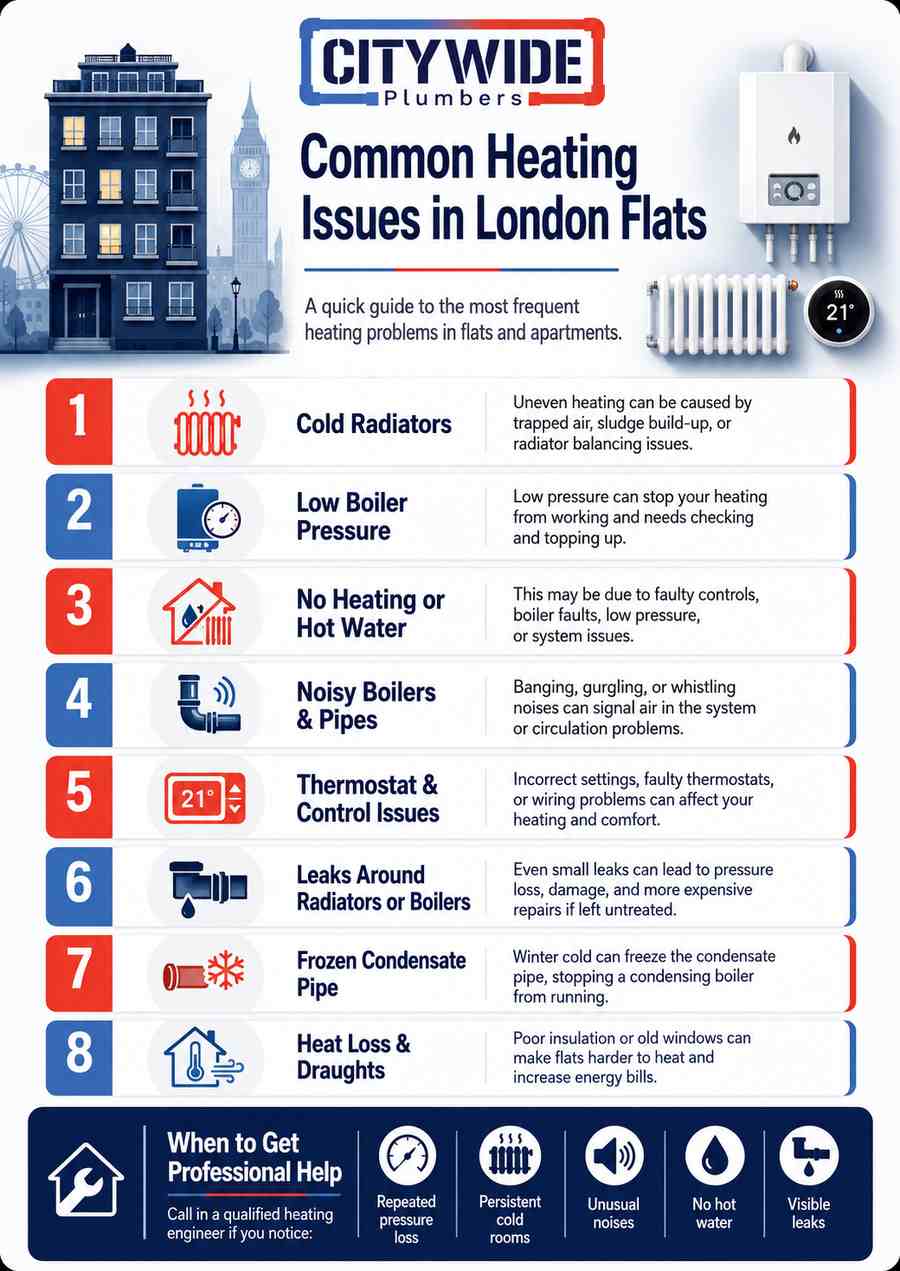
Click the infographic to view it larger
Why Heating Issues Are Common in London Flats
Flats in London can put extra pressure on heating systems because the layout, building age and access conditions are often more complicated than in a standard house. A boiler may be fitted in a kitchen cupboard, hallway cupboard or tight utility space. Radiators may have been added at different stages of the property’s history. Pipework can run through floors, walls or shared spaces, making diagnosis less straightforward.
Another common factor is building type. Many flats in Fulham and wider London are located inside converted Victorian or Edwardian properties. These buildings can be attractive and full of character, but they were not originally designed for modern central heating. That means pipe routes, room insulation and radiator positioning may not always be ideal.
Purpose-built blocks and newer developments can also have issues. Some use communal or district-style heating arrangements, where a central system supplies heat or hot water to multiple flats. In those cases, the issue may not sit inside the flat itself. It may involve a heat interface unit, shared pipework, plant room equipment, billing systems or building management responsibilities.
- Older converted flats may have mixed pipework and radiator sizes
- Compact layouts can make boilers and valves harder to access
- Shared heating systems can make fault diagnosis more complex
- High usage during winter can expose weak components
- Draughts and poor insulation can make heating feel less effective
- Delayed servicing can allow small faults to develop gradually
Cold Radiators and Uneven Heat
One of the most common heating complaints in London flats is a radiator that does not heat properly. Sometimes the radiator stays cold at the top, sometimes it is warm at the top but cold at the bottom, and sometimes one room stays cold while the rest of the flat feels comfortable. Each pattern can point towards a different problem.
A radiator that is cold at the top may have trapped air inside it. When air collects in the radiator, hot water cannot circulate fully, so the radiator only warms partially. Bleeding the radiator can sometimes release trapped air, but if the problem returns often, there may be a deeper system issue that needs checking.
A radiator that is cold at the bottom may suggest sludge or debris inside the system. Over time, corrosion particles can collect inside radiators and pipework, reducing circulation. This can be more common in older systems or properties where the heating has not been maintained properly. In some cases, the system may need balancing, flushing or further investigation.
Uneven heating between rooms can also be linked to radiator size, valve settings, pipe layout, thermostat position or heat loss from windows and external walls. A professional heating assessment can help identify whether the problem is with the radiator itself, the boiler, the controls or the building fabric.
Low Boiler Pressure in Flats
Low boiler pressure is another frequent issue in London flats with individual combi boilers. Most sealed heating systems need pressure to circulate hot water through the radiators. If the pressure drops too low, the boiler may stop working, display an error code or fail to heat the radiators properly.
Pressure can drop after radiators have been bled, after a small leak, or because of a problem with the pressure relief valve, expansion vessel or internal boiler component. A one-off pressure adjustment may not always be serious, but repeated pressure loss should not be ignored.
Residents sometimes top up boiler pressure themselves using the filling loop, but this should only be done if they understand the boiler instructions and feel confident doing so. Over-pressurising a system can create further problems. If the pressure keeps dropping, the right solution is not simply to keep refilling it; the cause needs to be found.
| Symptom |
Possible Cause |
Recommended Action |
| Pressure drops after bleeding radiators |
Air released from the system |
Check the boiler manual and repressurise only if safe to do so |
| Pressure drops every few days |
Small leak, valve issue or expansion vessel fault |
Arrange a heating inspection |
| Boiler shows pressure-related error code |
System pressure outside safe operating range |
Stop resetting repeatedly and seek professional support |
| Pressure rises too high when heating is on |
Expansion vessel or pressure control issue |
Book an engineer to test the system |
If you are unsure, it is always better to ask for help rather than risk damaging the boiler or creating a leak inside a flat, where water damage can affect neighbours and shared areas.
No Heating or No Hot Water
Losing heating or hot water can be stressful, particularly in a flat where space is limited and alternative heating options may be restricted. The cause can range from a simple control setting to a boiler fault that requires professional repair.
Before assuming the boiler has failed, check the basics. Is the thermostat calling for heat? Is the programmer set correctly? Has the boiler lost power? Is there an error code on the display? Is the pressure too low? These simple observations can help a heating engineer understand the situation more quickly.
If you have hot water but no heating, the issue may relate to controls, valves, the diverter valve or central heating circulation. If you have heating but no hot water, the fault may sit in a different part of the boiler or hot water system. If both heating and hot water have stopped, the problem could be pressure, ignition, gas supply, power, controls or an internal boiler fault.
For rented flats, tenants should report heating and hot water problems to the landlord or managing agent as soon as possible. For owner-occupied flats, it is best to avoid repeated boiler resets and arrange a proper diagnosis if the issue does not clear quickly.
If your flat needs practical help with system checks, repairs or upgrades, professional Heating Services in London can help identify the fault and restore reliable heat safely.
Noisy Boilers and Pipework
Heating systems should not be completely silent, but loud banging, whistling, gurgling or knocking sounds are warning signs that something may not be right. In London flats, these noises can feel even more noticeable because boilers and pipework are often close to living spaces, bedrooms or shared walls.
Gurgling sounds may suggest trapped air in the system. Whistling or kettle-like noises can be linked to restricted water flow, scale, sludge or overheating inside parts of the boiler. Banging or knocking pipes may be caused by expansion, loose pipe clips, water hammer or circulation problems.
Some noises are minor, but others can indicate that the system is under strain. If the boiler noise is new, getting worse or linked to poor heating performance, it should be checked. Ignoring persistent noises may allow the underlying issue to become more expensive to repair later.
- Gurgling may point to trapped air or circulation problems
- Whistling can be linked to restricted flow or scale
- Banging pipes may suggest movement, pressure or flow issues
- Noises after heating starts can relate to expansion
- Persistent boiler noise should be inspected professionally
- Never open a boiler casing unless you are qualified to do so
Thermostat and Heating Control Problems
Sometimes the heating system itself is not the main problem. The issue may come from the thermostat, timer, programmer, smart control, radiator valves or communication between devices. This is especially common when controls have been upgraded but the rest of the system is older.
A thermostat placed in the wrong location can make a flat feel uncomfortable. If it sits too close to a radiator, sunny window, kitchen heat source or draughty hallway, it may read the temperature incorrectly. As a result, the boiler may switch off too early or run for longer than needed.
Smart thermostats can be useful, but they still need correct installation and settings. Wi-Fi issues, weak batteries, incorrect schedules and app settings can all affect heating performance. Thermostatic radiator valves can also stick, especially after long periods without use.
Good heating control is not only about comfort. It can help reduce wasted energy by heating the flat more accurately. If your heating comes on at the wrong times, fails to respond or overheats certain rooms, the controls should be reviewed as part of the wider heating system.
Leaks Around Radiators, Valves or Boilers
Leaks should always be taken seriously in flats because water can spread into floors, ceilings, neighbouring properties and communal areas. Even a slow drip from a radiator valve can cause stains, damaged flooring, mould risk and pressure loss in the heating system.
Common leak points include radiator valves, pipe joints, towel rails, boiler connections and pressure relief discharge pipes. Sometimes the leak is obvious. Other times, the first sign may be a boiler that keeps losing pressure, damp patches near pipe runs or discolouration around fittings.
If you notice water near electrical fittings, switch off the affected area if it is safe to do so and seek urgent help. Do not ignore leaks around boilers, and do not remove the boiler casing. A qualified engineer should inspect internal boiler leaks.
In flats with hidden pipework, leak detection may require careful investigation. Early action can prevent damage to your property and reduce the risk of disputes with neighbours or building management.
Frozen or Blocked Condensate Pipes
Many modern condensing boilers have a condensate pipe that carries acidic wastewater away from the boiler. In cold weather, exposed sections of this pipe can freeze, especially where the pipe runs outside or through an unheated area. When this happens, the boiler may shut down and show a fault code.
Frozen condensate pipes are more common during sudden cold snaps. Flats can be affected if the pipe exits onto a balcony, external wall, roof area or shared drainage route. A poorly installed or uninsulated condensate pipe can make the problem more likely.
Sometimes a frozen pipe can be thawed carefully with warm water, but residents should avoid unsafe access, boiling water, climbing out of windows or leaning over balconies. If the pipe is hard to reach, repeatedly freezing or connected to a more complex drainage setup, professional help is the safer option.
Long-term prevention may involve insulation, rerouting or upgrading the pipework. A heating engineer can advise whether the current condensate arrangement is suitable for the flat and the building layout.
Heat Loss, Draughts and Flat Layout Problems
Not every cold flat has a faulty boiler. Sometimes the heating system is working, but the property loses heat too quickly. This is common in older London flats with single glazing, poorly sealed windows, external walls, high ceilings, draughty doors or limited insulation.
Heat loss can make residents turn the heating up higher, which may increase running costs without solving the comfort problem. If one room is always cold, consider whether the radiator is too small, blocked by furniture, covered by curtains or positioned poorly for the room layout.
Open-plan flats can also create uneven heating. A thermostat in a warm living area may switch the boiler off before bedrooms or hallways reach a comfortable temperature. In other flats, radiators near large windows may struggle to keep up with heat loss during winter evenings.
A complete heating assessment should consider both the system and the building. Radiator balancing, upgraded controls, improved radiator sizing, draught-proofing and better maintenance can all help. For wider support, Expert Heating Solutions Across London can help homeowners and landlords make practical improvements that suit the property.
When to Call a Heating Engineer
Some heating checks are simple, such as reviewing thermostat settings, checking the timer, looking for visible leaks or noting an error code. However, anything involving gas, internal boiler parts, electrical safety, repeated pressure loss or persistent heating failure should be handled by a qualified professional.
You should arrange help if your boiler keeps switching off, pressure drops repeatedly, radiators stay cold after bleeding, the boiler makes unusual noises, hot water becomes unreliable, controls stop responding or you notice signs of leaking. It is also sensible to book an annual boiler service to reduce the risk of winter breakdowns.
For landlords, heating reliability is part of responsible property maintenance. For homeowners, early repairs can protect comfort, safety and the long-term condition of the heating system. For tenants, clear reporting and written records can help ensure problems are handled properly.
Heating faults in London flats can feel disruptive, but they are often easier to manage when the symptoms are recognised early. Whether you are dealing with cold radiators, boiler pressure problems, leaks, noisy pipework or unreliable controls, Citywide Plumbers can support heating repairs and practical maintenance for flats across Fulham and London.
Need Help with Heating Issues in a London Flat?
Citywide Plumbers provides professional heating and plumbing support for flats, homes and rental properties across Fulham and London.
Book reliable heating help and keep your flat warm, safe and comfortable.