Energy-efficient boilers are one of the most practical ways for homeowners in Fulham and across London to reduce wasted fuel, improve heating performance and keep household running costs under better control. Whether your current boiler is old, unreliable or simply using more energy than it should, understanding how efficiency affects your bills can help you make a smarter decision. Working with Citywide Plumbers gives homeowners clear guidance on boiler efficiency, servicing, repairs and replacement options before money is spent on the wrong solution.
A boiler does not need to stop working completely before it starts costing too much. Many older or poorly maintained boilers continue to heat the home, but they use more gas, take longer to warm rooms, struggle to deliver consistent hot water and place extra strain on internal components. Over time, that wasted energy can add up through higher bills, more frequent faults and reduced comfort.
This guide explains how energy-efficient boilers save money, why efficiency is about more than the boiler itself, and what Fulham homeowners should consider when deciding whether to service, repair or upgrade their heating system.
How Energy-Efficient Boilers Save Money Infographic
Use this visual guide to understand where boiler efficiency savings come from, including fuel use, heating controls, servicing, radiator performance and long-term value.
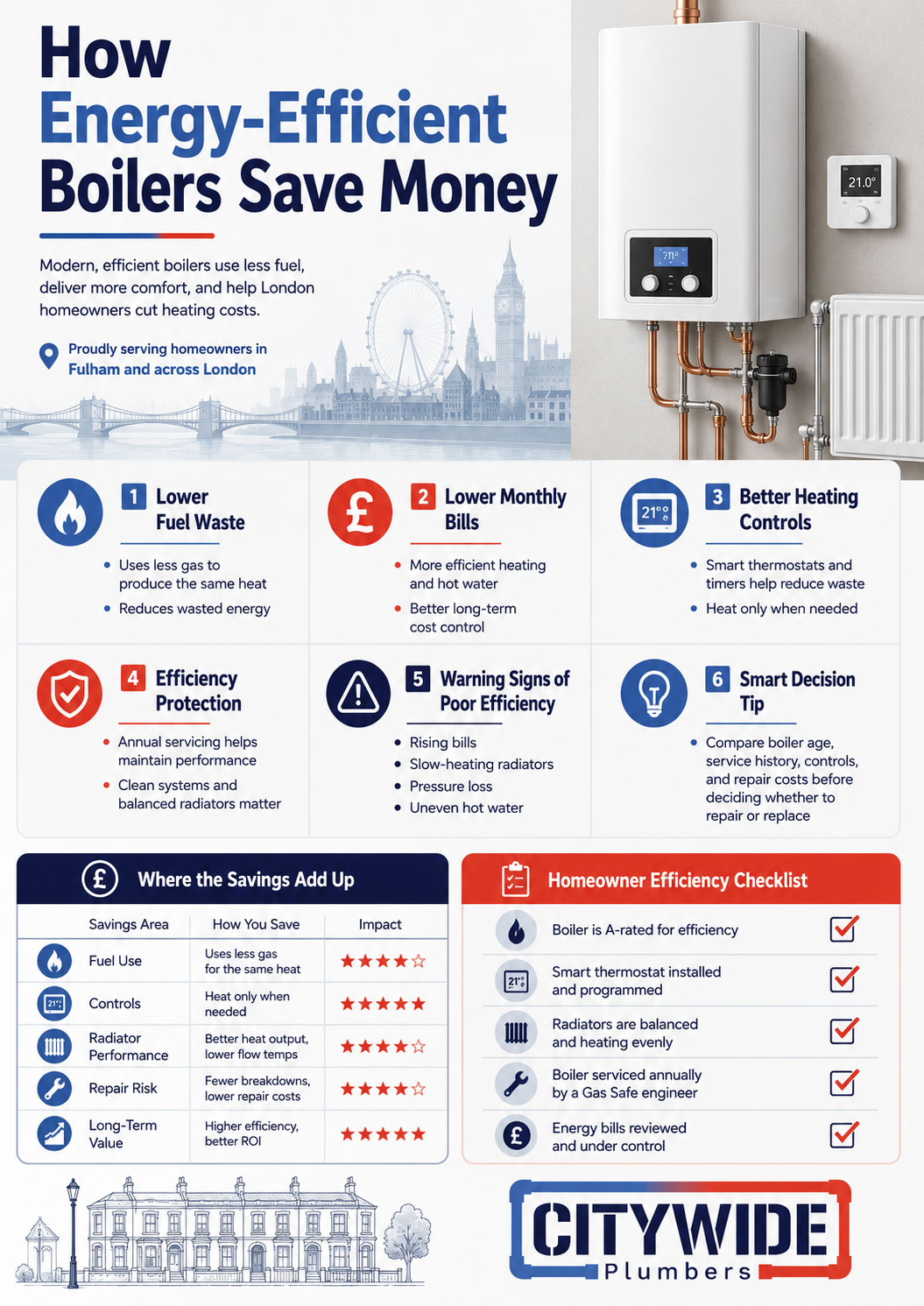
🔍 Click the infographic to enlarge
What Makes a Boiler Energy Efficient?
An energy-efficient boiler is designed to turn more of the fuel it uses into useful heat for your home. In simple terms, it wastes less energy. Modern condensing boilers are built to recover heat from flue gases that older systems may allow to escape. When properly installed, maintained and controlled, this can improve performance and reduce unnecessary fuel use.
However, boiler efficiency is not only about the appliance rating. The real performance of a heating system depends on several connected factors: the boiler size, the condition of the radiators, the cleanliness of the system water, the quality of the controls, the insulation of the property and how the household uses heating and hot water.
A high-efficiency boiler connected to poor controls, sludged radiators or badly balanced pipework may not deliver its full benefit. That is why professional assessment matters. The boiler should be treated as part of the whole heating system, not as a separate box on the wall.
- Modern condensing technology
- Correct boiler sizing for the property
- Good thermostat and timer control
- Clean radiators and healthy pipework
- Regular servicing and safety checks
- Efficient heating habits at home
How Efficient Boilers Reduce Fuel Waste
The main way an efficient boiler saves money is by reducing waste. If a boiler needs to burn more gas to achieve the same room temperature or hot water output, the extra fuel use appears on the bill. An efficient boiler aims to deliver the same comfort with less wasted energy.
Older boilers can lose efficiency for several reasons. Internal components wear over time, heat exchangers may become less effective, burners may need attention and controls may no longer manage the system properly. Even if the boiler still works, it may be working harder than necessary.
Fuel waste can also happen when the boiler cycles on and off too often, heats water beyond what is needed, or runs against poor circulation in the heating system. A professional service or heating inspection can help identify whether the issue is the boiler, the controls, the radiators or a combination of factors.
For homeowners booking a Boiler Service in Fulham, one of the biggest benefits is discovering whether the boiler is running as efficiently and safely as it should. Small maintenance issues can often be corrected before they turn into expensive faults.
- Less heat lost through poor operation
- Reduced unnecessary boiler cycling
- Better heat transfer to radiators
- Improved hot water consistency
- Lower strain on key boiler parts
- Fewer avoidable heating problems
How Energy-Efficient Boilers Help Lower Monthly Heating Bills
Heating and hot water are major parts of household energy use, especially during colder months. When the boiler operates efficiently, less fuel is needed to heat the same property. This can help reduce monthly running costs and make bills more predictable.
The saving will vary from property to property. A well-insulated home with good controls may see stronger results than a draughty property with heat loss through walls, windows or loft spaces. However, even in older London homes, improving boiler efficiency can make a noticeable difference when combined with sensible heating habits.
Efficient boilers can also reduce costs indirectly. A system that heats rooms more evenly may not need to run for as long. A boiler that delivers hot water consistently may reduce repeated reheating. Better controls can prevent heating empty rooms or running the system at full output when it is not required.
The goal is not just to install a newer boiler and hope for lower bills. The best results come from matching the boiler, radiators, controls and user settings to the needs of the property. This creates a heating system that works with the home rather than constantly fighting against it.
Better Heating Controls Can Save Money Too
A boiler may be efficient, but poor controls can still waste energy. If the heating comes on when nobody is home, runs too hot for too long or heats rooms that are not being used, money is being spent unnecessarily. Good controls help the boiler operate only when and where heat is needed.
Modern heating controls can include programmable thermostats, smart thermostats, thermostatic radiator valves and zoning options. These allow homeowners to set heating schedules, adjust temperatures and manage comfort more accurately. In busy London households, this can be especially useful because daily routines often change.
Even simple improvements can help. Lowering unnecessary high settings, using timers correctly, keeping thermostats away from draughts and ensuring radiator valves are working properly can improve system behaviour. A heating engineer can check whether your controls are suitable for your boiler and home layout.
The key point is that energy efficiency is not only about buying a new appliance. A well-serviced boiler with properly used controls may perform better than a newer boiler managed poorly. Controls are often one of the most cost-effective ways to reduce waste.
- Programmable heating schedules
- Better room temperature control
- Reduced heating of unused spaces
- Improved comfort during cold periods
- Less unnecessary boiler operation
- More predictable energy use
Why Regular Boiler Servicing Protects Efficiency
Regular servicing helps keep a boiler safe, reliable and efficient. During a service, an engineer can inspect the appliance, check key components, test safe operation and identify early signs of wear. This is important because a boiler can become less efficient gradually, long before a full breakdown occurs.
Small issues can affect performance. A sensor problem, pressure issue, poor combustion, worn part or circulation problem may make the boiler work harder than it should. When these issues are found early, they may be easier and cheaper to address.
A service history is also valuable when deciding whether to repair or replace the boiler. If the appliance has been maintained well and remains in good condition, repair may be sensible. If servicing reveals recurring concerns, age-related wear or signs of inefficient operation, replacement may become more cost-effective.
For landlords and homeowners in Fulham, servicing also supports peace of mind. A properly checked boiler is less likely to surprise you with avoidable winter faults. It may also help maintain warranty conditions where applicable.
- Helps maintain safe boiler operation
- Identifies early signs of inefficiency
- Reduces the risk of avoidable breakdowns
- Supports better long-term heating performance
- Creates a useful service history
- Can protect warranty requirements
Repair or Replace an Inefficient Boiler?
If your boiler is using more energy than expected, replacement is not always the first answer. Sometimes the cause is a repairable fault, poor system pressure, air in the radiators, a control issue or a lack of servicing. In these cases, a targeted repair or service may restore better performance without the cost of a new installation.
However, replacement may be more economical when the boiler is old, inefficient, unreliable or expensive to repair. If the boiler needs repeated callouts, struggles to meet demand, uses more fuel than it should and has limited parts availability, the long-term cost of keeping it may become higher than upgrading.
A good engineer should explain the realistic options. Repair may save money today, while replacement may save more over several years through better efficiency, stronger warranty cover and fewer breakdowns. The decision should be based on the boiler’s age, fault history, safety, performance and future use of the property.
Many households choose Expert Boiler Installation, Repairs & Servicing when they want one team to inspect the system, explain the likely costs and recommend a practical route without pushing an unnecessary replacement.
Energy-Efficient Boiler Savings Comparison
The table below shows where money can be saved when a boiler and heating system work efficiently. The exact saving depends on the property, boiler condition, controls and household usage, but the principle remains the same: less waste usually means lower long-term cost.
| Efficiency Area |
How Money Is Saved |
What Homeowners Should Check |
| Fuel Use |
Less gas is wasted when heat is produced efficiently |
Boiler age, servicing history and operating condition |
| Heating Controls |
The system runs only when heat is needed |
Timer settings, thermostat location and radiator valves |
| Radiator Performance |
Rooms heat faster and more evenly |
Cold spots, sludge, trapped air and balancing issues |
| Repair Risk |
A well-maintained boiler is less likely to fail unexpectedly |
Annual servicing, pressure changes and unusual noises |
| Long-Term Value |
Efficient systems can reduce waste and improve comfort |
Whether repair or replacement offers better future savings |
This is why the cheapest option is not always the best option. A low-cost repair may be ideal for a healthy boiler, but poor value for a failing system. A new boiler may cost more upfront, but may be better value if the existing appliance is wasting fuel and needing constant attention.
Fulham and London Property Factors That Affect Boiler Efficiency
Fulham homes come in many different layouts, including flats, terraces, conversions, mansion blocks and larger family properties. Each property type can affect heating efficiency in a different way. A boiler that works well in one home may not be the right solution for another.
Older London properties may have heat loss through windows, walls, roofs or older pipework routes. Some homes may have radiators that are not correctly sized for the rooms. Others may have long pipe runs, poor water pressure or heating systems that have been altered over many years. These factors can reduce efficiency even when the boiler itself is capable.
Access and space can also influence decisions. In compact flats, boiler location, flue route and condensate drainage must be considered carefully. In larger homes, the boiler must be able to meet hot water and heating demand without being oversized or undersized.
A professional assessment helps identify whether money is being lost through the boiler, the controls, the radiators, the pipework or the building itself. This prevents homeowners from spending heavily on one upgrade while ignoring the real source of waste.
Warning Signs Your Boiler Is Not Running Efficiently
Many efficiency problems appear gradually. You may not notice one major failure, but you may see small signs that the boiler is no longer performing as well as it should. Acting early can help prevent higher bills and more expensive repairs later.
Common warning signs include radiators taking too long to heat, hot water temperature changing unexpectedly, unusual boiler noises, pressure dropping, pilot or ignition problems, error codes, frequent resets or heating bills rising without a clear reason. These symptoms do not always mean the boiler must be replaced, but they should not be ignored.
Cold spots on radiators can suggest circulation problems or sludge. A boiler that fires up repeatedly for short periods may be cycling inefficiently. A home that never feels warm despite high settings may have control, insulation or system design issues.
The sooner the cause is identified, the easier it is to choose the right solution. Sometimes a service, repair, power flush or control adjustment may improve efficiency. In other cases, replacement may be the most practical long-term answer.
- Rising heating bills without clear reason
- Radiators heating slowly or unevenly
- Boiler pressure dropping frequently
- Hot water temperature changing suddenly
- Unusual banging, gurgling or whistling noises
- Repeated error codes or resets
Final Money-Saving Advice for Energy-Efficient Boilers
An energy-efficient boiler can save money by reducing wasted fuel, improving heating control, lowering the strain on components and helping the home reach comfortable temperatures more effectively. However, the best results come from looking at the whole system, not only the boiler.
If your boiler is fairly modern, a service or targeted repair may be enough to restore better performance. If it is old, unreliable and expensive to run, replacement may offer stronger long-term value. The decision should always consider safety, efficiency, age, repair history, warranty cover and the condition of radiators and controls.
For Fulham homeowners, landlords and property managers, improving boiler efficiency is not only about lower bills. It is also about comfort, reliability and avoiding urgent breakdowns during colder months. A planned approach is almost always better than waiting until the boiler fails completely.
Whether you need servicing, repairs, efficiency advice or a new boiler assessment, Citywide Plumbers can help you understand the most cost-effective way to improve your heating system and reduce unnecessary energy waste.
Want to Improve Boiler Efficiency in Fulham?
Citywide Plumbers provides professional boiler servicing, boiler repairs, boiler installation and heating system support for homes and rental properties in Fulham and across London.
Improve heating performance and reduce wasted energy with expert boiler support.