When a boiler starts making noises, losing pressure, leaking, showing fault codes or failing to heat water properly, many homeowners face the same question: is it cheaper to repair the existing boiler or replace it with a new one? For households in Fulham and across London, the right answer depends on the boiler’s age, condition, fault history, efficiency and how long you plan to stay in the property. Working with Citywide Plumbers helps you compare short-term repair costs against long-term savings before making a decision.
A small repair can be the smartest option when the boiler is relatively modern, parts are available and the fault is isolated. However, repeated breakdowns, rising energy bills, poor hot water performance and expensive parts can make replacement more cost-effective over time. This guide explains how to compare boiler repair and replacement properly, so you can choose the option that protects your comfort, budget and property value.
Boiler Repair vs Replacement Infographic
Use this quick visual guide to compare repair costs, replacement value, warning signs and long-term savings before deciding what to do with your boiler.
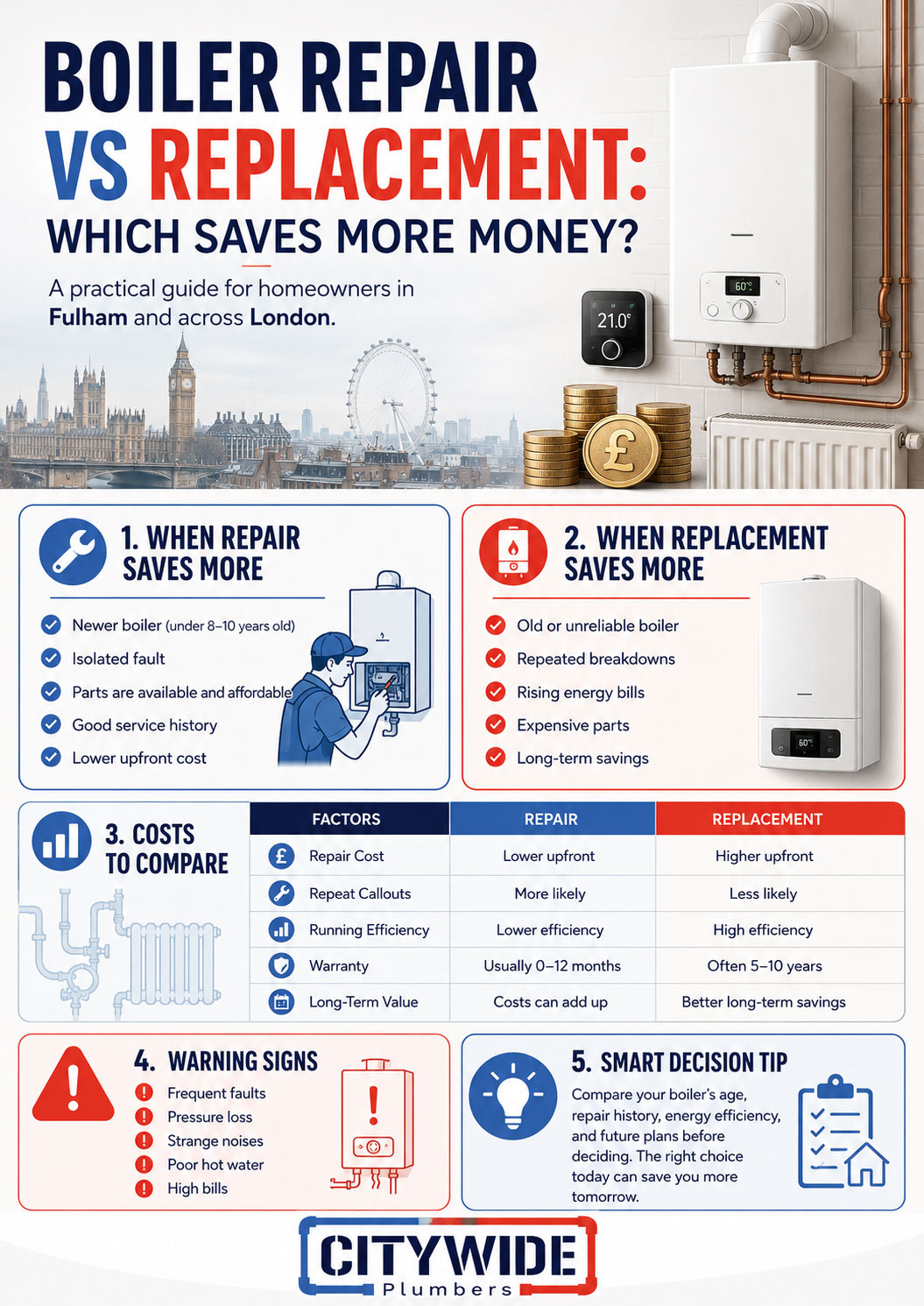
🔍 Click the infographic to enlarge
×
Repair or Replace: What Is the Real Difference?
Boiler repair is usually a targeted fix. A qualified engineer identifies the fault, replaces or adjusts the affected part and restores the boiler to working condition. This may involve components such as valves, sensors, pumps, fans, ignition parts, pressure-related parts or controls. Repair is normally faster and cheaper upfront, especially when the boiler is otherwise safe and efficient.
Boiler replacement is a wider investment. Instead of fixing one fault, the old boiler is removed and a new unit is installed. This may also include flushing the system, upgrading controls, adapting pipework, improving condensate arrangements and checking the wider heating system. Replacement costs more at the start, but it may reduce future breakdowns, improve efficiency and provide warranty protection.
The key is not simply asking, “Which is cheaper today?” The better question is, “Which option saves more money over the next few years?” A £200 repair may be sensible on a well-maintained five-year-old boiler. The same repair may be poor value on a 14-year-old boiler that has already needed several callouts.
- Repair is usually cheaper upfront
- Replacement can reduce long-term repair risk
- Efficiency affects the real cost over time
- Old boilers may have harder-to-source parts
- Warranty cover can add value to replacement
- Safety and reliability should guide the decision
When Boiler Repair Saves More Money
Repair usually saves more money when the boiler is still within a reasonable working life, has been serviced regularly and has developed one clear fault rather than several connected problems. If the boiler has been reliable until now, replacing one failed component may restore normal performance without the need for a full installation.
Repair can also make sense when the property owner is not planning to stay in the home long-term. For example, if you are selling or refurbishing a property soon, a safe and professional repair may be enough to keep the heating system running properly. However, this should never mean ignoring serious faults or safety concerns.
Another good reason to repair is when the boiler is still under manufacturer warranty. If the issue is covered, the cost may be much lower than expected. Even outside warranty, common parts can often be replaced efficiently if the model is widely supported.
Homeowners searching for Boiler Service in Fulham often discover that regular maintenance helps identify repairable issues before they become expensive emergencies. A service history can also make it easier for an engineer to judge whether the boiler is worth keeping.
- The boiler is less than around ten years old
- The fault is isolated and affordable to fix
- Parts are available without long delays
- The boiler has a good service history
- Heating and hot water performance are still strong
- The repair cost is low compared with replacement
When Boiler Replacement Becomes the Smarter Choice
Replacement starts to make more financial sense when the boiler is old, inefficient, unreliable or expensive to repair. If the same system keeps breaking down every winter, the total cost of repeated repairs can quickly become higher than the value of the boiler itself.
Age is an important factor. Boilers do not all fail at the same time, but older units are more likely to suffer from worn components, corrosion, control problems and reduced efficiency. Even if each fault seems separate, the pattern may show that the appliance is reaching the end of its practical life.
Replacement may also be the better choice when the existing boiler struggles to meet the household’s demand. A growing family, extra bathroom, loft conversion or property renovation can expose the limits of an undersized or outdated boiler. In these cases, repairing the old unit may not solve the real problem.
There are also situations where safety and compliance must come first. If an engineer identifies serious defects, poor flue arrangements, unsafe operation or major internal deterioration, replacement may be the most sensible route. Gas boiler work should always be handled by a suitably qualified Gas Safe registered engineer.
The Hidden Cost of Repeated Boiler Repairs
Many homeowners compare only the price of today’s repair against the price of a new boiler. This can be misleading. A single repair may look affordable, but three or four callouts over two winters can become a much bigger financial burden.
Repeated repairs also create inconvenience. A boiler breakdown often happens when the heating is needed most. Emergency callouts, waiting for parts, temporary loss of hot water and disruption to family life all carry a cost, even if that cost is not always shown on the invoice.
Another hidden cost is uncertainty. If you are constantly wondering whether the boiler will fail again, the system is no longer giving dependable value. Landlords, busy households and homeowners with elderly relatives or young children may place a higher value on reliability.
A useful rule is to compare the repair cost with the age and future risk of the boiler. If a major repair costs a large percentage of the price of replacement, and the boiler is already old or unreliable, replacement may be more economical in the long run.
- Multiple callouts increase the real annual cost
- Parts and labour may rise as the boiler gets older
- Breakdowns can disrupt heating and hot water
- Emergency repairs are often more stressful
- Old faults can return if the system is deteriorating
- Reliability has financial value for busy homes
Energy Efficiency and Monthly Heating Bills
Energy efficiency is one of the biggest reasons replacement can save money over time. Older boilers may use more fuel to deliver the same level of heating and hot water. A modern condensing boiler, when installed correctly with suitable controls, can often operate more efficiently and help reduce wasted energy.
However, efficiency savings depend on the property, insulation, heating controls, household usage and the condition of the wider system. A new boiler is not a magic fix for every high bill. If radiators are sludged, controls are poor, pipework is badly designed or the home loses heat quickly, those issues should also be reviewed.
This is why a proper assessment matters. An engineer should not only look at the boiler casing and fault code. They should consider system pressure, radiator performance, hot water demand, thermostat control, pipework condition and whether the boiler is correctly matched to the property.
In many cases, the best saving comes from combining the right boiler decision with good servicing, sensible controls and a clean heating system. Repair may save money today, but replacement may reduce running costs if the old boiler is inefficient and unreliable.
Boiler Age, Spare Parts and Warranty Protection
The age of the boiler has a major impact on the repair-versus-replacement decision. A newer boiler with available parts and a clear service history is usually a stronger candidate for repair. An older boiler with obsolete parts, recurring faults and no warranty may be a weaker candidate.
Spare parts availability can also affect cost. If parts are common and easy to source, repair can be practical. If parts are discontinued, delayed or unusually expensive, replacement may be the better option. Waiting several days for a critical component during cold weather can be extremely inconvenient.
Warranty matters too. A new boiler may come with manufacturer warranty protection, depending on the model, installation quality and servicing requirements. This can reduce the risk of unexpected repair bills in the early years after installation. A repair on an old boiler may only cover the specific part or work carried out.
Before deciding, ask whether the repair is likely to give reliable service or simply delay another breakdown. A professional assessment should explain the condition of the boiler, the cost of the fault, the availability of parts and whether replacement would offer better long-term value.
Boiler Repair vs Replacement Cost Comparison
The table below gives a practical way to think about the decision. It does not replace an engineer’s inspection, but it can help you understand which option is more likely to save money in different situations.
| Situation |
Repair May Save More Money When |
Replacement May Save More Money When |
| Boiler age |
The boiler is fairly modern and has been reliable |
The boiler is old, worn or near the end of its life |
| Fault type |
The issue is minor, isolated and affordable to fix |
The fault is major, repeated or linked to wider deterioration |
| Energy bills |
The boiler is already efficient and correctly controlled |
The boiler wastes energy and struggles to heat the home |
| Parts |
Parts are available quickly at a sensible cost |
Parts are obsolete, delayed or expensive |
| Long-term plans |
You need a short-term practical fix |
You want long-term reliability and warranty protection |
The best decision is rarely based on one factor. A boiler may be old but still reliable, or fairly new but poorly installed. This is why the engineer’s diagnosis, your budget and your plans for the property should all be considered together.
Special Boiler Considerations for Fulham and London Homes
Fulham properties can vary widely, from compact flats and mansion blocks to terraced houses, conversions and larger family homes. This variety affects boiler decisions. Access, flue position, water pressure, cupboard space, shared walls, parking and building layout can all influence repair and replacement costs.
In some flats, replacing a boiler may require careful planning around flue routes, condensate drainage and building access. In older homes, the wider heating system may need attention before a new boiler can perform properly. Radiator sludge, ageing pipework or poor controls can reduce the benefit of replacement if they are not addressed.
Repair may be more attractive when access is difficult or when the existing installation is otherwise suitable. Replacement may be better when the current boiler location is poor, the system is outdated or the property is being renovated. If you are improving a kitchen, bathroom or whole heating system, it can be more efficient to plan boiler replacement as part of the wider work.
For landlords in London, reliability and documentation are especially important. Regular servicing, safe operation and prompt repairs help protect tenants and reduce emergency disruption. If an old boiler is causing repeated tenant complaints, replacement may offer better value than ongoing reactive repairs.
How Boiler Servicing Helps You Make the Right Decision
Boiler servicing is one of the best ways to avoid unnecessary replacement and prevent avoidable repairs. During a service, an engineer can check key components, inspect the appliance, test safe operation and identify early signs of wear. This gives you a clearer picture of the boiler’s condition before a breakdown happens.
A service can also help separate a minor issue from a bigger pattern. For example, pressure loss may be caused by a simple external leak, but it could also point to a failing component. Noisy heating may relate to trapped air, sludge, pump issues or heat exchanger problems. A proper inspection helps identify the most sensible next step.
If the boiler is working well after servicing and only needs a small repair, replacement may not be necessary. If the service reveals multiple concerns, poor combustion, ageing parts or signs of deterioration, replacement may become the safer and more economical choice.
Many homeowners choose Expert Boiler Installation, Repairs & Servicing because they want one team to assess the boiler, explain the options and recommend a practical solution rather than pushing a replacement too early.
- Servicing can reveal early warning signs
- It helps maintain safe boiler operation
- It supports warranty and service history records
- It can reduce the risk of winter breakdowns
- It helps compare repair value against replacement
- It gives homeowners clearer cost information
Final Verdict: Which Option Saves More Money?
Boiler repair usually saves more money when the boiler is modern enough, the fault is minor, parts are available and the appliance has been reliable. In this situation, replacing the whole boiler may be unnecessary. A professional repair can restore heating and hot water at a lower immediate cost.
Boiler replacement usually saves more money when the boiler is old, inefficient, unreliable or expensive to repair. If you are paying for repeated callouts, waiting for parts, dealing with poor hot water or seeing rising bills, replacement may deliver better long-term value. The upfront cost is higher, but the benefits can include improved reliability, better controls, warranty cover and lower repair risk.
The smartest approach is to get a proper diagnosis before deciding. Do not replace a boiler just because of one fault, but do not keep repairing a failing system simply because each individual repair feels cheaper. Look at the full picture: age, safety, efficiency, repair history, parts, warranty and your future plans for the property.
For homeowners, landlords and property managers in Fulham and across London, Citywide Plumbers can help assess whether boiler repair or replacement is the more cost-effective route, giving you clear advice before you spend money on the wrong solution.
Need Help Choosing Between Boiler Repair and Replacement?
Citywide Plumbers provides professional boiler servicing, boiler repairs, boiler installation and heating support for homes and rental properties in Fulham and across London.
Get expert boiler advice before you commit to repair or replacement.